Torna alla lista dei post
Maximize lead quality: the importance of digital contact capture
Ultima modifica: April 24, 2026


80% of manually captured leads never receive follow-up, resulting in significant revenue loss. Digital contact capture improves data accuracy, speeds up processing, and enhances lead quality. A successful strategy blends automation with careful manual handling where needed, emphasizing data hygiene and user adoption.
80% of manually captured leads never receive a follow-up. That single statistic should stop any sales or marketing leader in their tracks. Every trade show badge scan, every handwritten form, every stack of paper business cards collected at a conference represents a potential deal that quietly disappears into a spreadsheet nobody updates. Digital contact capture changes that equation entirely. In this article, we walk through why manual methods consistently underperform, where digital tools deliver real competitive advantage, and how enterprise teams can build a contact strategy that generates predictable, measurable revenue.
Key Takeaways
| Point | Details |
|---|---|
Manual methods cause loss | Traditional contact collection leads to high lead loss and inefficiencies. |
Digital capture increases quality | Automation and integration significantly boost lead quality and response speed. |
Some edge cases need manual | Manual methods are still best for complex, low-volume, or high-security scenarios. |
Success requires data hygiene | Long-term results depend on maintaining data quality and strong team adoption. |
Why manual contact capture falls short
Most sales teams still rely on familiar manual practices: collecting paper business cards, compiling trade show attendance lists, or asking prospects to fill out handwritten forms at events. These methods feel tangible and straightforward. In practice, they create serious operational drag.
Here are the most common pain points we see with manual contact capture:
- Data entry errors: Transcribing handwritten notes introduces typos, wrong phone numbers, and misspelled names that corrupt your CRM from day one.
- Duplicate records: Without automated deduplication, the same contact often gets entered multiple times across different team members.
- Lost records: Paper cards get misplaced. Spreadsheets go unsaved. Event lists sit in someone’s inbox for weeks.
- Slow processing: Manual workflows delay lead engagement by days or even weeks, long after the prospect’s interest has cooled.
- No scalability: A team of two can manage a small card stack. A team of fifty attending a major conference cannot.
The downstream cost is significant. Manual delays mean 80% of leads collected this way never receive any follow-up at all. That is not a minor inefficiency. That is a revenue leak at scale.
“The longer a lead waits for follow-up, the colder it gets. Manual processes don’t just slow teams down, they actively cost deals.”
Think about professionals in specialized fields. Digital business cards for lawyers and other high-stakes industries illustrate exactly why accuracy and speed matter. A mistyped contact or a delayed follow-up in those contexts can mean a lost client relationship worth thousands. The same logic applies across business cards for every industry, from financial services to technology sales.
Having established that manual methods leave much to be desired, let’s look at how digital capture solves these issues.
The power of digital contact capture
Digital contact capture automates the most error-prone parts of lead collection. Instead of transcribing a name from a paper card, a QR code scan or NFC tap pushes contact data directly into your CRM in seconds. The difference in data quality is immediate and measurable.
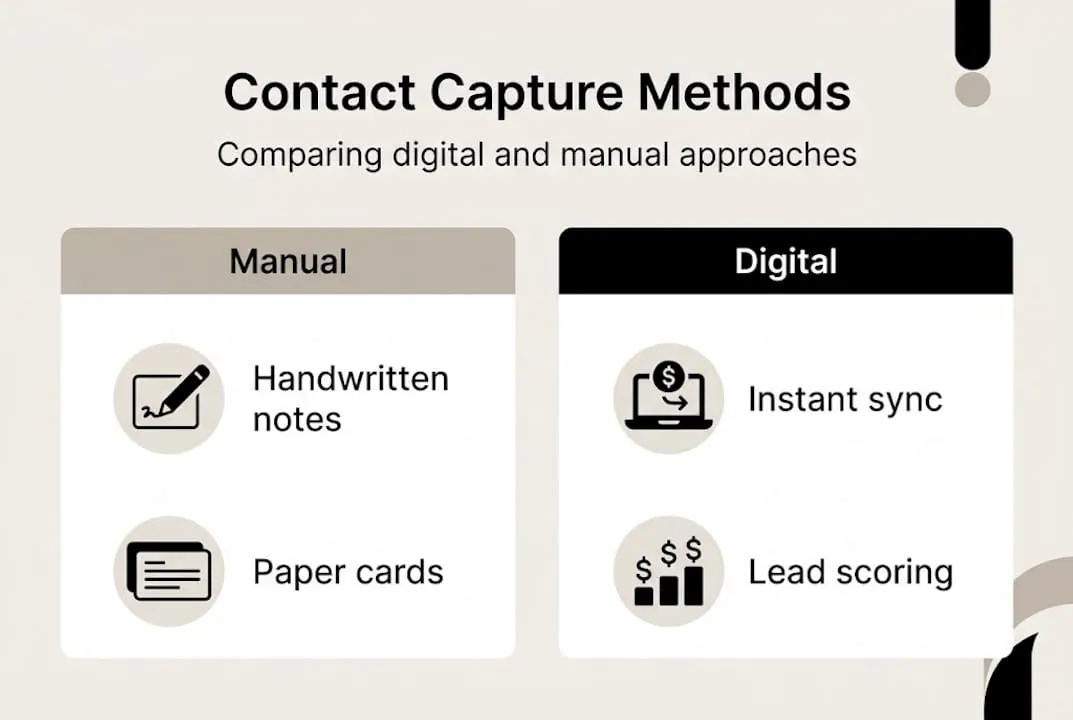
Here is a direct comparison of what digital tools deliver versus manual methods:
| Feature | Manual capture | Digital capture |
|---|---|---|
Data entry accuracy | Low (human error) | High (automated) |
Duplicate prevention | None | Automated deduplication |
CRM sync speed | Hours to days | Real-time |
Lead scoring | Manual, inconsistent | Automated, rule-based |
Offline capability | Always available | Available with right platform |
Post-event processing | Hours of admin work | 80% faster processing |
Beyond speed, digital capture enables real-time lead scoring and routing. The moment a contact is captured, it can be automatically scored based on firmographic data, assigned to the right sales rep, and enrolled in a nurture sequence. That kind of speed to lead is simply not possible with manual workflows.
Research also shows that lead quality improves 68% YoY when teams switch to digital capture methods. Better data means better segmentation, better personalization, and ultimately better conversion rates.

For digital cards for consultants and other client-facing professionals, the ability to capture a contact in a meeting and have it synced to your contact manager solutions before you leave the room is a genuine competitive advantage.
Pro Tip: Always choose a platform that supports offline contact capture. Events in convention centers, hotels, or international venues frequently have unreliable WiFi. If your tool requires a live connection to save data, you will lose contacts at exactly the moments that matter most.
After establishing digital’s inherent benefits, it’s important to examine where manual methods still hold an edge, and to compare the two directly.
When digital isn’t always best: key edge cases
Digital contact capture is not a universal solution. There are real scenarios where manual methods outperform or usefully supplement digital tools, and good enterprise strategy accounts for both.
Here is a side-by-side look at where each approach performs best:
| Scenario | Best approach | Why |
|---|---|---|
High-volume trade show | Digital | Speed, accuracy, CRM sync |
Small private meeting | Either | Low volume, personal context |
Complex legal or financial docs | Manual | Human verification required |
High-security environments | Manual | Reduces digital exposure risk |
GDPR/CCPA-regulated capture | Digital with consent flows | Automated compliance tracking |
Remote or offline events | Digital (offline-capable) | No WiFi dependency |
For complex or non-standard documents, small event volumes, or environments with strict security requirements, manual methods for complex data remain the more reliable choice. Human verification adds a layer of judgment that automated systems cannot replicate.
Privacy compliance is another area where digital tools require careful design. GDPR and CCPA both require explicit consent before you store or process contact data. A well-built digital capture platform automates those consent flows, but only if it is configured correctly. A poorly designed system can actually increase your compliance risk.
Key considerations for a balanced approach:
- ✅ Use digital capture for all high-volume, repeatable scenarios
- ✅ Retain manual processes for sensitive or complex data collection
- ⚠️ Never assume digital tools are compliant out of the box. Audit your consent flows.
- ⚠️ Data hygiene is not automatic. Digital tools accumulate bad data just as fast as manual ones if nobody maintains them.
The ideal enterprise strategy blends both methods. Digital handles scale and speed. Manual handles nuance and sensitivity. Review your security and privacy for contact capture practices regularly to ensure your setup meets current regulatory standards.
With a more nuanced understanding, the focus shifts to how digital contact capture delivers end-to-end value at the enterprise scale.
Scaling and integrating digital contact capture for predictable revenue
For mid-sized to large enterprises, the real value of digital contact capture is not just speed. It is what happens after the contact is captured. When your capture tools integrate directly with CRM platforms like Salesforce or HubSpot, every new contact immediately enters your revenue engine.
Here is a practical action plan for scaling digital capture across your organization:
- Audit your current contact workflows. Map every touchpoint where contacts are collected, from events to web forms to sales calls. Identify where data gets lost or delayed.
- Identify integration gaps. Check whether your capture tools sync in real time with your CRM. If they do not, that gap is costing you lead velocity.
- Automate nurturing sequences. Once a contact enters your CRM, automated workflows should trigger immediately. Segment by industry, role, or intent signal for more personalized outreach.
- Build a 360-degree contact view. CRM integrations for predictable revenue give your team full context on every contact, from first touch to closed deal.
- Educate your team. Adoption is the single biggest barrier to ROI. Run short training sessions and make digital capture the path of least resistance.
For specialized verticals, the integration benefits are especially pronounced. Solutions for financial advisors and digital cards for realtors both benefit from having every client interaction logged automatically, creating a complete relationship history without manual data entry.
Pro Tip: Assign a named owner for data hygiene on your team. Without clear accountability, duplicate records, outdated contacts, and incomplete fields accumulate quickly. One person reviewing and cleaning contact data monthly can dramatically extend the useful life of your CRM.
Having grasped the strategic and operational value, it’s time to wrap up with a perspective on what leaders often miss.
The uncomfortable truth: digital capture’s success depends on data hygiene and user adoption
We have seen this pattern repeatedly. A sales or marketing leader invests in a modern digital capture platform, rolls it out to the team, and expects the results to follow automatically. Six months later, the data is a mess and adoption is patchy at best.
The technology is not the problem. The assumption is.
Digital tools are enablers, not operators. Over-reliance on digital without active data hygiene practices leads to the same decay you were trying to escape from manual methods. Contacts go stale. Fields go unfilled. Duplicates creep back in.
The organizations that get the most from digital contact capture treat it as an ongoing discipline, not a one-time implementation. They schedule regular data audits. They train new team members on capture standards. They track adoption metrics alongside lead quality metrics.
Your virtual business cards and contact manager are only as powerful as the habits built around them. The real competitive advantage is not the tool itself. It is the team culture that keeps the data clean, current, and actionable.
Take your contact capture to the next level
If you are ready to move beyond spreadsheets and paper cards, KADO Networks offers a purpose-built platform for exactly this challenge. From customizable digital business cards shared via QR code, NFC, or link, to real-time contact capture and CRM sync, KADO is designed for enterprise teams that need both scale and compliance.

Explore the full digital business card platform to see how teams are replacing manual workflows with secure, automated contact capture. You can also discover how NFC business cards make in-person capture instant, and how the virtual contact manager keeps your entire contact ecosystem organized and actionable. Start capturing leads the right way.
Domande Frequenti
What is digital contact capture?
Digital contact capture is the process of collecting, organizing, and integrating business contacts using digital tools instead of manual methods. It eliminates errors and duplicates while enabling real-time CRM sync and lead scoring.
How does digital contact capture improve lead quality?
By automating data entry and enabling instant scoring, digital capture increases accuracy and allows faster, more personalized follow-up. Teams consistently see lead quality improve 68% YoY after switching from manual methods.
Are there situations where manual contact capture is better?
Yes. Manual works best for complex or non-standard documents, small event volumes, or high-security environments where human verification adds critical value.
Does digital contact capture help with compliance?
Yes, digital capture can support compliance by automating consent flows and maintaining proper records. Platforms built with GDPR and CCPA consent flows built in make regulatory alignment far more manageable than manual tracking.