Go back to list of posts
MWC Barcelona 2026 Guide: IQ Era Networking + ROI Tips!
Last modified: February 26, 2026


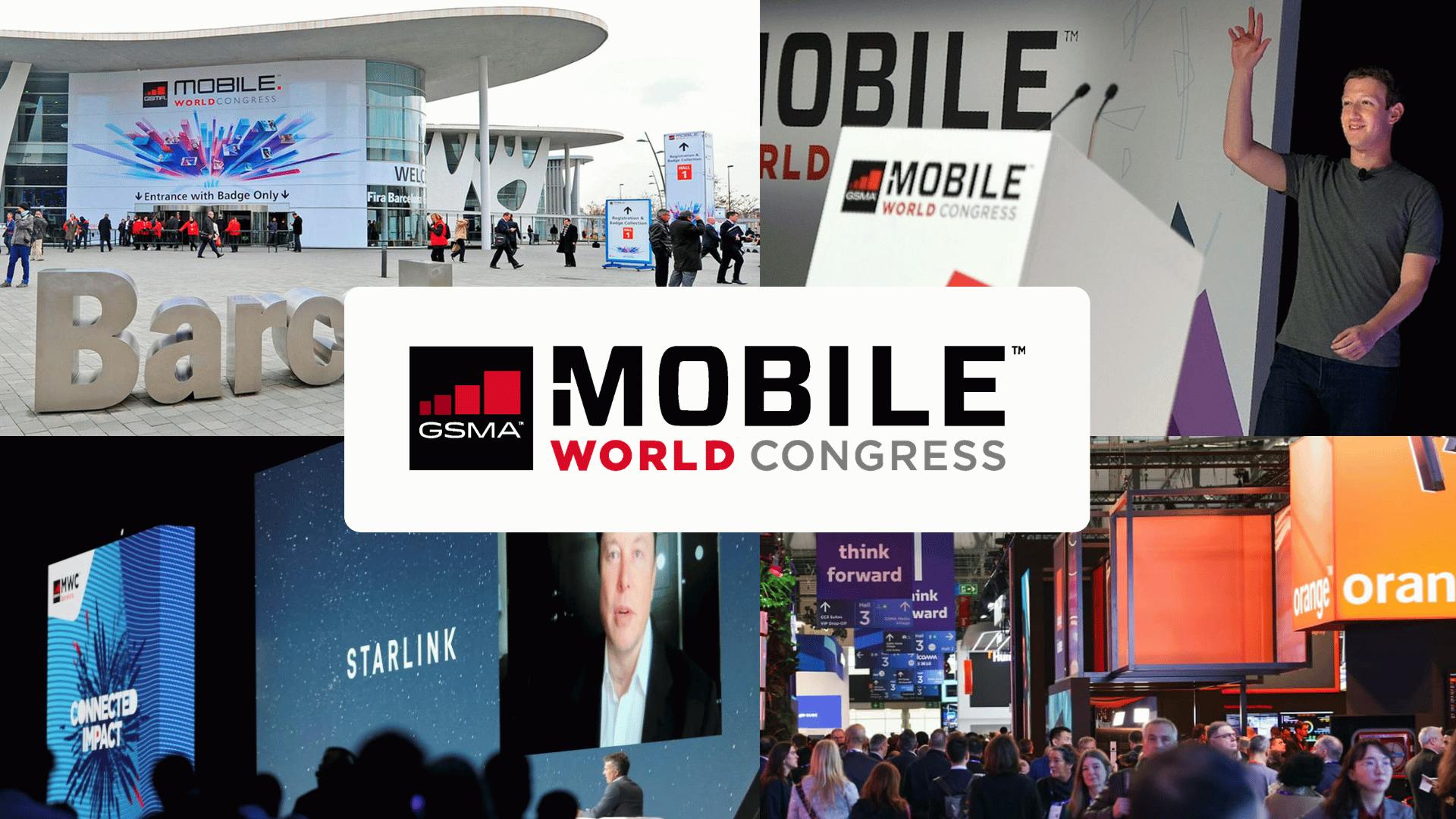
Mobile World Congress (MWC) Barcelona 2026 runs 2–5 March 2026 at Fira Gran Via in Barcelona.
MWC is where the global connectivity ecosystem concentrates into four intense days—operators, device makers, cloud and edge platforms, satellite players, security leaders, policy-makers, and the adjacent industries building on top of networks. If you’ve ever said, “I need six months of meetings,” this is the week where you can compress that timeline—if you arrive with a system.
This guide is written to meet Google’s “helpful, people-first” expectations: clear facts, practical preparation, and realistic strategies that help attendees convert conversations into outcomes. You’ll also see exactly how MWC’s networking infrastructure works (and how to use it), plus a focused section on why KADO is the best tool to network at this event.
MWC Barcelona 2026 at a glance
| Detail | What to know |
|---|---|
Dates | 2–5 March 2026 |
Venue | Fira Gran Via, Barcelona |
2026 event theme | The IQ Era |
Keynote access | Keynotes require a Leader’s Conference or VIP Pass |
Co-located ecosystem | MWC includes co-located experiences such as 4YFN (startup event) |
What makes MWC different from “another tech conference”
MWC isn’t just big; it’s structurally designed to connect the people who build networks with the people who monetize them. The showfloor is where deals happen, but the real advantage is the variety of “meeting contexts” happening simultaneously: formal sessions, curated speaker networking, exhibition conversations, country pavilions, lounges, and private receptions that create a steady stream of high-intent encounters.
MWC also matters because it sits at the intersection of regulation, standards, infrastructure investment, and mass-market technology cycles. When industry priorities shift (privacy, spectrum, AI on-device vs. cloud, satellite-to-cell, network APIs, post-quantum security), MWC is where the narrative gets negotiated in public and then executed in private meetings.
The IQ Era: how the 2026 theme shapes what you’ll hear (and what people will ask you)
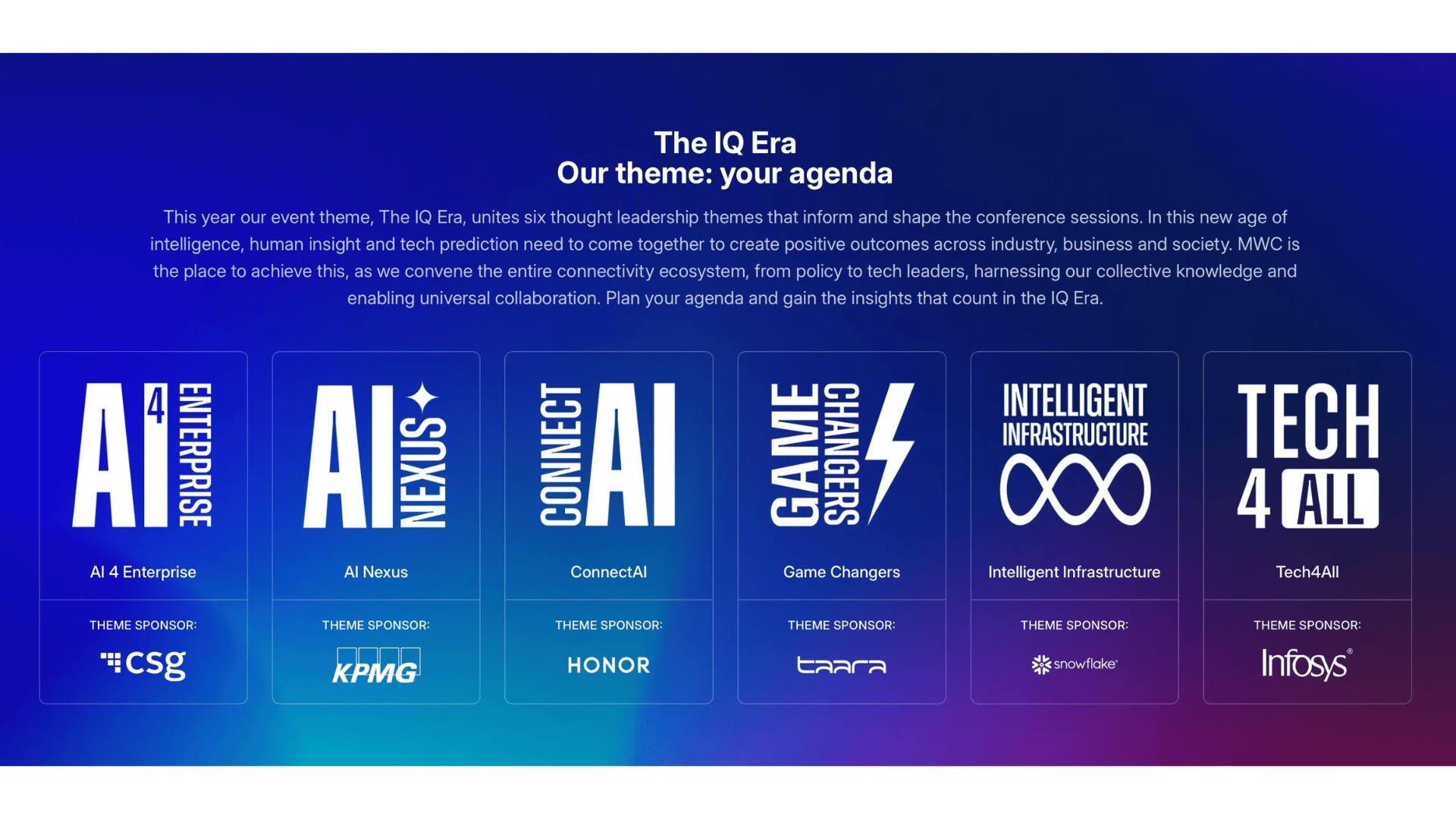
MWC’s 2026 theme is The IQ Era, framed around the idea that in a world saturated with data, “human insight” and tech capability must combine to drive outcomes for business and society.
In practice, this theme changes the tone of conversations. You’ll see less patience for vague “innovation theatre” and more pressure for clarity: measurable ROI, responsible deployment, and concrete implementation paths. Even if you’re not an AI company, you should expect AI-shaped questions in almost every meeting: “How does this reduce cost, reduce risk, speed up decisions, or create new revenue?”
A useful mental model: The IQ Era is not “AI hype.” It’s “AI + infrastructure + governance + execution.”
Who should attend (and how to win based on your role)
Founders and startup teams
MWC is the fastest way to validate whether your positioning holds up under global scrutiny. You can meet enterprise buyers, channel partners, and strategic investors in the same day, but the win condition is not “more conversations.” The win condition is qualified next steps: a demo booked, a pilot discussed, or a partner intro confirmed with a date.
Enterprise and corporate innovation leaders
MWC is a scouting environment, but the best corporate teams don’t “browse.” They arrive with 2–3 internal priorities, a shortlist of capabilities they want to evaluate, and a clear procurement reality. That specificity magnetizes higher-quality meetings because founders can tell you’re not just collecting ideas—you’re mapping solutions to real adoption paths.
Investors
MWC can look noisy, but it’s extremely useful for thesis building. It’s one of the few places where you can test a view across the entire stack: devices → networks → cloud/edge → security → applications. If you structure your time around themes and meeting zones rather than random booth walks, you’ll get better signal density.
A practical “4-day meeting system” that actually converts
MWC is intense. You want a strategy that’s simple enough to run while you’re tired, walking, and context-switching all day.
| Timeframe | What you do | Why it works |
|---|---|---|
10–14 days before | Pick 3 objectives (e.g., 12 demos booked, 8 partner talks, 5 investor meetings) and build a short target list | Prevents random scheduling |
3–5 days before | Confirm meetings, share 1–2 lines of context, and set a clear agenda for each | Raises meeting quality instantly |
During the event | Capture contact + context immediately after each conversation | Stops lead loss and misremembering |
0–48 hours after | Send recap + proposed next step + scheduling link | Converts event energy into pipeline |
One sentence that keeps this system honest: If there’s no next step scheduled, the meeting isn’t finished.
(And yes, this is where personal branding quietly shows up: people follow up with the person who feels clear, credible, and easy to work with.)
Telefónica at MWC26: a high-signal stop if you care about real deployments
Telefónica has publicly shared its MWC26 presence: Hall 3 – stand 3K31, with demonstrations of innovative solutions and an Agora that hosts open events with industry experts, top speakers, and live demos, with sessions available online on-demand.
If you’re building in connectivity-adjacent spaces—IoT, edge, security, critical communications, or enterprise mobility—large operators and their innovation programs can be some of the best “reality-check” conversations you’ll get all week. They’ll quickly tell you what integrates cleanly, what doesn’t, and what enterprise buyers actually approve.
If you’re evaluating ecosystem partnerships, the operator booths are often where you can understand distribution pathways that are hard to see from the outside.
(And if you’re exhibiting at MWC, take note: this is also where corporate branding becomes operational—your booth is not decoration; it’s your sales environment.)

Why KADO is the perfect networking tool for MWC Barcelona 2026
MWC moves fast, and the biggest threat to ROI isn’t a lack of conversations—it’s losing the good ones. In four days, you can meet dozens of high-value people across halls, lounges, and spontaneous booth conversations. The problem is that traditional contact exchange is fragile: one typo, one “I’ll add you later,” one badge photo you never revisit—and a strong lead quietly disappears.
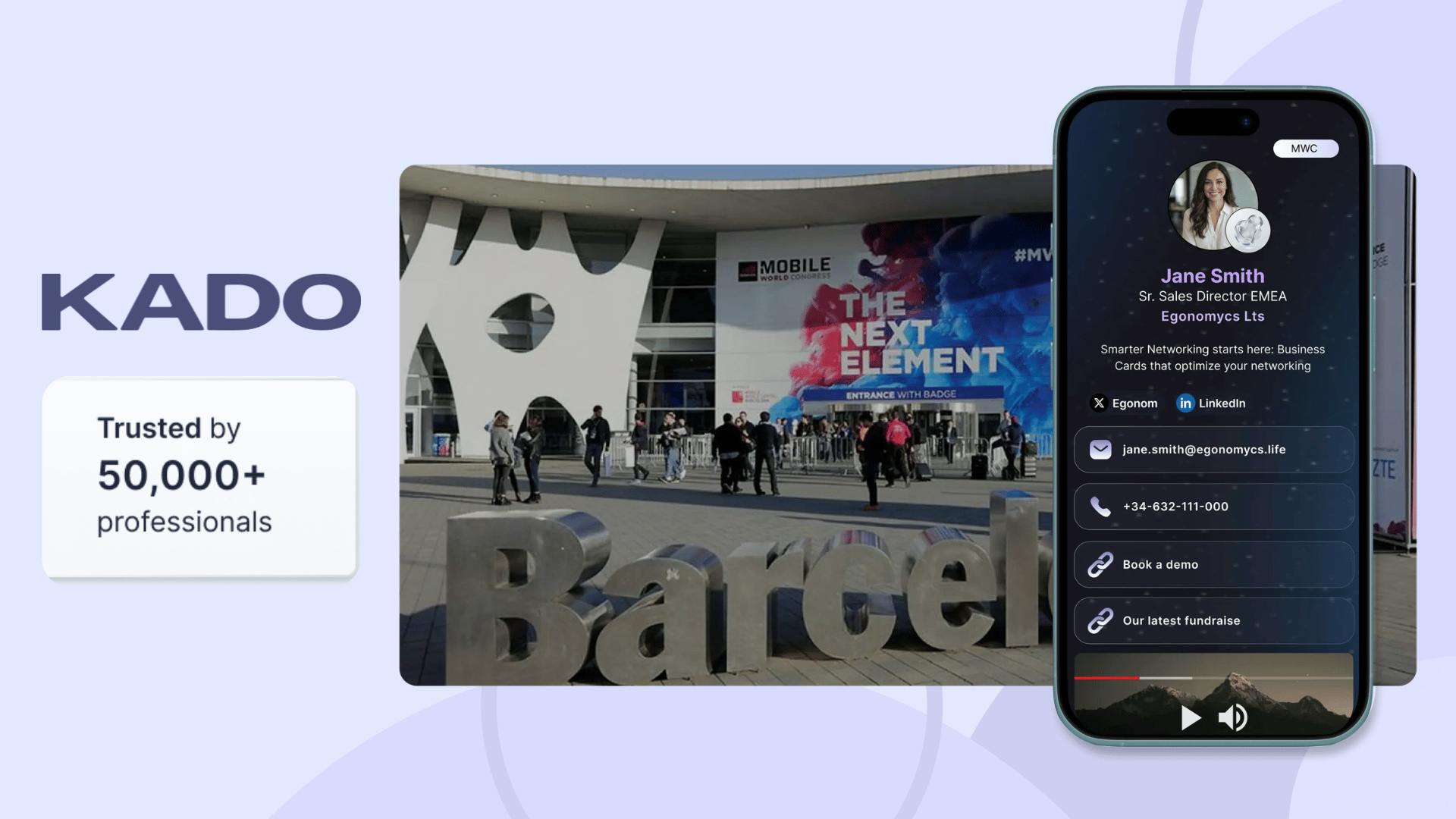
KADO solves that by making the exchange instant and reliable. You share your digital business card in seconds, so the other person walks away with accurate, complete details—no retyping, no missing info, no dependency on memory after a long day. That speed matters at MWC because the best opportunities often happen between meetings, not during them.
The real advantage is what happens next: KADO helps you leave MWC with contacts you can actually act on. Instead of a messy pile of scattered notes and half-remembered names, you have a clean, professional foundation for follow-up—so your best conversations turn into booked calls, demos, and partnership discussions while the event is still fresh.
If you want a deeper comparison framework, start here: Best Digital Business Cards Guide
Final thoughts: how to leave MWC with outcomes, not just impressions
MWC Barcelona 2026 is the kind of event where attention is expensive and time moves fast. If you arrive with clear objectives, use MWC’s meeting tools intelligently, and remove follow-up friction with KADO, you’re not just attending—you’re operating.
And at MWC, operators win.
Frequently Asked Questions
When is MWC Barcelona 2026?
MWC Barcelona 2026 runs 2–5 March 2026.
Where is MWC held?
MWC Barcelona takes place at Fira Gran Via in Barcelona (L’Hospitalet de Llobregat area).
Do keynote sessions require a special pass?
Yes. MWC indicates keynote access is limited to attendees with a Leader’s Conference or VIP Pass.
How does MWC help attendees network?
MWC highlights networking design through tools like MWC Connect and dedicated spaces such as Leaders Lounges to build relevant meeting schedules.