Torna alla lista dei post
Digital business card sharing benefits for enterprise growth in 2026
Ultima modifica: April 24, 2026


Enterprises are shifting to digital cards for instant sharing, real-time updates, and better data control. Digital cards provide measurable benefits like analytics, CRM integration, and scalable deployment. Security, compliance, and strategic training are key to successful adoption of digital card sharing.
Physical business cards have dominated professional networking for decades, yet 50% networking efficiency gain separates enterprises using digital card sharing from those still relying on paper alone. That gap is not a minor operational footnote. It represents real pipeline velocity, measurable lead capture rates, and brand consistency across hundreds of distributed reps. In this article, we walk through why enterprise teams are abandoning the card stock entirely or rethinking how they use it, what measurable benefits digital card sharing delivers, how to handle security and compliance, and what a practical implementation strategy looks like for your team.
Key Takeaways
| Point | Details |
|---|---|
Digital cards boost networking ROI | Switching to digital card sharing can improve enterprise networking efficiency and enable better analytics. |
Hybrid solutions close more deals | Combining physical and digital cards bridges audience preferences and has a measurable impact on deal rates. |
Security and branding are enhanced | Enterprises gain more control over data privacy, brand consistency, and compliance with digital card solutions. |
Adoption drives competitive advantage | Teams that strategically implement digital card sharing outperform those sticking to traditional methods. |
Why enterprises are shifting to digital card sharing
Now that we’ve previewed the rising potential of digital card sharing, let’s look at what is driving this enterprise-wide shift.
Physical business cards work fine when you hand them to one person at a small gathering. Scale that to a 500-person sales force attending dozens of industry conferences each quarter, and the cracks show fast. Cards get lost. Reps run out at the worst moment. Design updates require reprints. And not one of those exchanges generates a data point your marketing team can act on.
Digital card sharing solves these problems at the root. Instead of static printed cards, reps share a living profile via QR code, NFC tap, or a simple link. That profile can be updated instantly across the entire team. A product rebrand, a new phone number, a fresh campaign landing page — every contact a rep has ever shared with receives the current version automatically.
For enterprise leadership, the real shift is about visibility and control. Enterprise features like team dashboards, role-based access, brand consistency enforcement, and centralized analytics finally give management a way to measure the ROI of networking efforts. Which reps are sharing cards most actively? Which events are generating the most follow-up conversations? These questions now have answers.
Here is what that shift looks like in practice for enterprise sales and marketing teams:
- ✅ Centralized brand control — One template update reaches every rep’s card instantly
- ✅ Role-based permissions — Managers control what information each team tier can edit or share
- ✅ Real-time analytics — Track card shares, contact captures, and follow-up rates by rep or region
- ✅ CRM integration — Contacts flow directly into Salesforce, HubSpot, or any connected system
- ✅ Scalable distribution — Onboard 10 or 10,000 reps without reprinting a single card
Enterprises across digital cards for every industry are realizing that moving to digital is not just an environmental choice. It is a data strategy. When every card share becomes a trackable event, networking transforms from a soft activity into a measurable growth driver.
Digital vs. physical cards: Pros, cons, and hybrid trends
Understanding the drivers, it’s essential to weigh digital solutions against traditional and hybrid models.
Neither digital nor physical cards win outright. The right choice depends on your audience, context, and what outcome you are optimizing for. Let’s look at how they stack up.
| Feature | Physical cards | Digital cards | Hybrid (NFC + QR) |
|---|---|---|---|
Sharing speed | Slow, manual | Instant, contactless | Instant with tactile feel |
Updateability | Requires reprint | Real-time edits | Real-time edits |
Analytics | None | Full tracking | Full tracking |
CRM integration | Manual entry | Automated sync | Automated sync |
C-suite perception | High (formal) | Growing acceptance | Strongest for B2B |
Cost at scale | High (reprints) | Low | Medium |
The data reinforces this nuance. Physical cards are preferred by 82% of C-suite contacts in formal settings, while hybrid NFC and QR solutions close more deals in high-value B2B environments. Pure digital suits tech-forward sales teams and startup ecosystems where speed matters most.
“The best networking strategy is not either-or. It is knowing your audience well enough to meet them where they are, physically and digitally.”
For most enterprise teams, the hybrid approach delivers the widest coverage. NFC business cards give you the physical weight that resonates in boardroom settings, while the embedded digital layer captures data and syncs contacts automatically. Pairing NFC cards with QR code digital cards ensures you can reach contacts even when NFC scanning is not available on their device.
Pro Tip: Map your event calendar by audience type before choosing your card format. Investor meetings and executive dinners call for NFC-enabled physical cards. Tech conferences and trade shows are where pure digital shines. A tiered strategy costs less and performs better than a one-size approach.
Core benefits: Digital card sharing supercharges enterprise networking
Let’s dive deeper into the core benefits enterprises experience when digital card sharing is implemented.
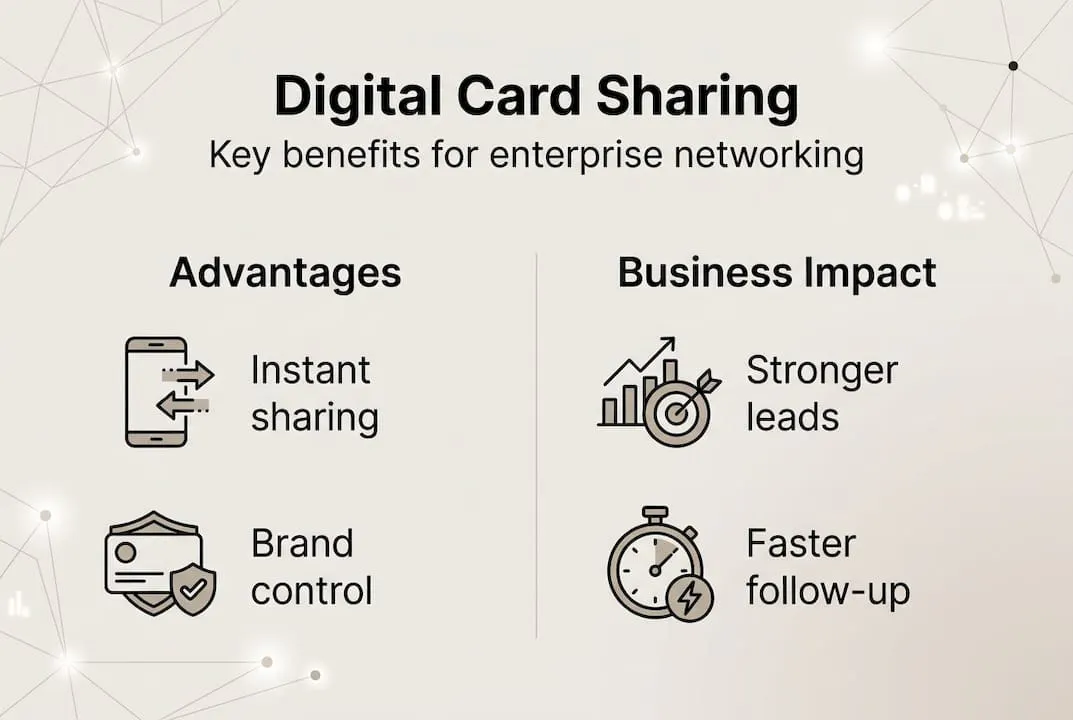
The operational gains from digital card sharing stack up quickly. Here is a structured look at the primary benefits and what drives each one:
| Benefit | What it enables | Business impact |
|---|---|---|
Instant sharing | No more “I forgot my cards” moments | Higher contact capture at events |
Centralized dashboards | Real-time rep activity tracking | Faster coaching and performance feedback |
CRM sync | Contacts enter pipeline automatically | Shorter time from meeting to follow-up |
Brand templates | Consistent messaging across all reps | Reduced compliance risk |
Analytics per share | Track who opened your card | Prioritize warm leads intelligently |
Digital cards deliver team dashboards, role-based access, and centralized analytics that translate networking activity into business outcomes leadership can act on. That is the core promise, and it holds up in practice.
Here is a numbered walkthrough of how digital card sharing improves the full sales cycle:
- Capture — Rep shares a card via QR or NFC at an event; contact details are captured instantly
- Qualify — Analytics show who engaged with the card, viewed links, or opened follow-up content
- Sync — Contact is pushed automatically to your CRM with the rep’s name, event tag, and date
- Nurture — Marketing automation triggers a follow-up sequence within minutes of the exchange
- Measure — Dashboards reveal which events, reps, and campaigns generate the highest ROI
Pro Tip: When your rep shares a card, add a quick note or tag before closing the app. Context like “Met at Booth 12, interested in Q3 pricing” gives your CRM automation something meaningful to act on. Pair this with your contact management solutions to build a smarter follow-up flow.
Overcoming challenges: Security, compliance, and adoption
While the benefits are compelling, concerns around security and adoption remain — here’s how enterprises handle them.

Every enterprise decision maker we talk to raises three questions before rolling out digital cards: Is it secure? Does it meet our compliance requirements? And will our team actually use it?
These are fair questions. Here is how strong digital card platforms address each one:
Security
- 🔒 End-to-end encryption protects all contact data in transit and at rest
- 🔒 Role-based access ensures reps only see and share what they are authorized to
- 🔒 Centralized admin controls let IT revoke access instantly if a device is lost or a rep departs
- 🔒 Audit trails log every share, edit, and export for full accountability
Compliance
- Enterprise-grade features like role-based access and centralized analytics support GDPR, CCPA, and internal governance requirements. Customizable access levels mean you control exactly what data is stored and who can retrieve it.
Adoption
Adoption is often where rollouts stall. The fix is straightforward but requires intention. Training sessions should focus on the daily workflow benefit, not the technology itself. Show reps how a 10-second card share at an event becomes a CRM entry without any manual work. That moment clicks fast.
“Leadership buy-in is the single biggest adoption driver. When managers use their digital cards visibly and reference the analytics in team meetings, rep adoption follows within weeks.”
Coupled with security, compliance, and governance features built for enterprise-scale environments, digital card platforms remove the barriers that slow IT and legal approvals.
A smarter networking future: The real opportunity for enterprise teams
Now that we’ve covered practical solutions, let’s challenge the typical thinking with our own perspective.
Most enterprise teams evaluate digital card platforms the same way they evaluate any SaaS tool: features list, price per seat, integration count. That thinking misses the bigger opportunity entirely.
The real value of digital card sharing is not in the tool. It is in what becomes possible when your networking activity generates structured, actionable data for the first time. Hybrid cards close 23% more B2B deals, yet most organizations underinvest in the integration and training that make that stat achievable.
We see teams spend weeks selecting a platform and then deploy it without a tagging strategy, CRM mapping, or follow-up playbook. The cards go live. Reps share them. Nothing connects. The analytics sit unused.
The enterprises that win are the ones that treat digital card sharing as a process, not a product. They define what a “successful exchange” looks like, they build the CRM fields to capture it, and they review the data in pipeline meetings. That is when the see digital cards in action conversation becomes obvious and inevitable.
Physical presence still matters. A confident handshake and a well-designed NFC card at a boardroom meeting carry real weight. But the follow-up, the nurture, the attribution — those belong to the digital layer. Teams that integrate both thoughtfully will outperform those chasing either extreme.
Get started with digital card sharing for your enterprise
Ready to move your team’s networking capabilities to the next level? Here’s how to get started.
KADO Networks is built for exactly the use cases we’ve covered here: enterprise teams that need brand control, CRM integration, analytics, and security without sacrificing ease of use. Whether your reps are financial advisors, pharma professionals, or field sales teams, we have tailored solutions ready.

Explore digital cards for financial advisors or digital cards for pharma professionals to see how industry-specific features map to your workflows. When you’re ready to see the full platform in action, our virtual business card demo walks you through every feature your team needs to launch with confidence. The setup is fast, the impact is immediate, and the data starts working for you from the first share.
Domande Frequenti
What makes digital card sharing better than physical cards for enterprises?
Digital card sharing offers real-time analytics, automated lead capture, centralized brand control, and unlimited scalability — advantages physical cards simply cannot match. Centralized analytics for ROI measurement give enterprise leaders visibility that paper cards never could.
How secure is sharing contact details with digital cards?
Robust platforms use encryption, role-based access, and audit trails to protect contact data at every step. Role-based access features ensure only authorized team members can view or export contact information.
What is the ROI of digital card sharing for sales teams?
Digital card sharing can improve networking efficiency by 50% compared to traditional cards, with built-in analytics making lead follow-up faster and more targeted.
How can enterprises encourage adoption of digital cards by staff?
The most effective approach combines hands-on training focused on daily workflow benefits with visible leadership use and regular analytics reviews in team meetings. Demonstrating quick wins with usage data accelerates buy-in across all levels of the organization.