Go back to list of posts
Sales Networking Trends 2026: What You Need to Know
Last modified: July 8, 2026


Sales networking in 2026 is defined by AI-augmented relationship building, real-time behavioral signals, and warm introductions that replace cold outreach as the primary pipeline driver. Explaining sales networking trends 2026 requires understanding one core shift: buyers now complete 60–70% of their decision-making before they ever talk to a seller. That means reactive outreach arrives too late. The professionals winning deals this year build trust before a need is even expressed, using AI to spot the right moment and connectors to open the right door.
How are AI and real-time signals transforming sales networking?
AI’s most powerful role in sales networking is not writing emails. AI excels at signal detection and matching, identifying prospects who show active buying intent through job changes, funding announcements, product launches, and leadership transitions. That distinction matters because most teams still use AI as a content generator, which produces volume without relevance.

Signal-based outreach changes the math entirely. Event-triggered outreach sent within hours of a funding round or leadership change yields response rates 5–10 times higher than baseline cold methods. The reason is simple: you are reaching someone at the exact moment their priorities are shifting and their budget is in motion.
Here is what high-performing teams track as buying signals:
- Funding rounds — a company that just raised Series B is actively building its tech stack
- Leadership changes — a new VP of Sales often replaces existing vendors within 90 days
- Job postings — hiring for a specific role signals a gap the right vendor can fill
- Product launches — expansion creates new pain points and new budgets
- Content engagement — a prospect liking or commenting on relevant posts signals active research
Pro Tip: Set up Google Alerts and LinkedIn notifications for your top 20 target accounts. When a signal fires, reach out the same day. Speed is the differentiator, not the message.
The practical implication is that your CRM workflow needs a signal layer. High-performing teams use AI to aggregate signals from LinkedIn, news feeds, and intent data platforms, then route alerts to the right rep automatically. The rep’s job shifts from prospecting to responding with context and speed.
Why are warm introductions outperforming cold outreach in 2026?
Cold email is functionally broken as a primary channel. Cold email reply rates have fallen to roughly 2% in 2026, while connector-based warm introductions achieve 40–50% reply rates and require 20–25 times fewer contacts to fill the same pipeline. That is not a marginal improvement. It is a structural argument for rebuilding how you source meetings.
The connector model works because trust transfers. When a respected mutual contact introduces you, the prospect’s skepticism drops before you say a word. AI scales this model by mapping your network to identify which connectors have relationships with your target accounts, then suggesting the optimal introduction path.
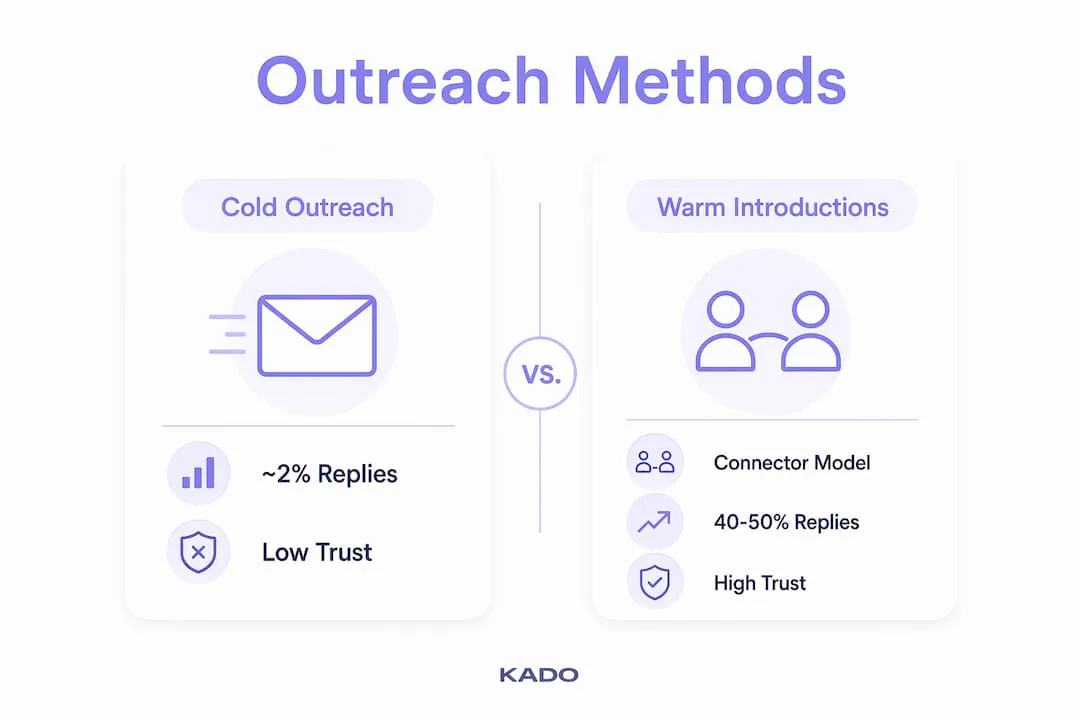
| Outreach method | Typical reply rate | Contacts needed to book 10 meetings |
|---|---|---|
Cold email | ~2% | 500+ |
LinkedIn cold connection | ~5% | 200+ |
Multi-touch sequence | 11%+ | 90–100 |
Warm introduction | 40–50% | 20–25 |
Regulated industries feel this shift most acutely. Fintech and cybersecurity require trusted warm introductions not just for efficiency but for compliance and buyer confidence. A cold email from an unknown vendor in these sectors rarely clears the inbox, let alone the legal review.
The double opt-in introduction is the gold standard. The connector asks both parties if they are open to the introduction before making it. This respects everyone’s time, increases the quality of the conversation, and protects the connector’s reputation. Sales professionals who adopt this practice report stronger connector relationships over time because they never put their network contacts in an awkward position.
Pro Tip: Map your connectors by relationship seniority and historical reply rates, not just by how many connections they have. A connector with 500 contacts who responds and refers is worth more than one with 5,000 who never engages.
Top sales organizations measure connector quality by tracking which introductions convert to meetings and which meetings convert to pipeline. This ROI-focused mapping replaces the old habit of counting LinkedIn connections as a proxy for network strength.
What social selling habits actually build pipeline in 2026?
Generic content is the fastest way to become invisible on LinkedIn. Top social selling teams avoid AI-generated posts and instead spend 15–30 minutes daily engaging directly with content from targeted prospects. That daily habit builds familiarity before any outreach happens.
Substantive engagement means leaving comments that add a perspective, asking a follow-up question, or sharing a relevant data point. It does not mean clicking “Like” and moving on. Prospects notice who engages thoughtfully with their content, and that recognition shortens the trust-building cycle significantly.
The daily social selling routine for 2026 looks like this:
- Review your target account list — check for new posts from decision-makers at your top 20 accounts
- Leave one substantive comment — add a real perspective, not a compliment
- Share one piece of original insight — a short observation from a customer conversation or industry data point
- Send one personalized connection request — reference something specific from their recent activity
- Follow up on pending conversations — move existing threads forward with a question or resource
Substantive engagement beats AI-generated content floods because it signals human authenticity. Buyers have become skilled at detecting templated messages and generic posts. A thoughtful comment on a prospect’s post about a specific challenge they mentioned is worth more than 10 polished articles published to no one in particular.
The balance between automation and manual effort matters here. Automation handles initial connection requests and follow-up reminders. Manual effort handles every conversation that involves real context, a specific reference, or a relationship that is moving toward a meeting. Mixing these up is where most teams lose credibility.
How do you execute 2026 networking strategies within your sales team?
Execution is where most teams stall. The strategy sounds clear, but the daily workflow breaks down without structure. Here is how to build a system that holds:
- Build a signal stack. Assign one team member to configure alerts for funding, leadership changes, and job postings across your target account list. Review signals weekly as a team.
- Map your connector network. List your top 20 connectors, note their relationship to your target accounts, and track which introductions they have made and converted. Update this quarterly.
- Run multi-touch sequences. Multi-action outreach sequences combining profile views, connection requests, and follow-ups push reply rates above 11%, nearly doubling single-touch outreach below 6%. Sequence timing matters: space touches 3–5 days apart.
- Personalize at the signal level. Every outreach message should reference the specific signal that triggered it. “I saw you just hired a Head of Revenue Operations” is more effective than any generic opener.
- Automate the logistics, not the relationship. Use automation for scheduling, reminders, and CRM data entry. Successful teams combine automation for initial outreach with manual interaction for relationship-building phases to avoid buyer pushback.
- Track follow-up timing. The fastest follow-up wins. Set a personal rule: respond to any signal or inbound engagement within four hours during business hours.
- Review your networking best practices quarterly. What worked in Q1 may not work in Q3 as buyer behavior shifts.
Compliance awareness belongs in this workflow too. In regulated sectors, document your introduction process and confirm that your outreach respects any communication restrictions your prospects operate under. A warm introduction that violates a compliance boundary damages both relationships.
Key Takeaways
Sales networking in 2026 requires AI-powered signal detection, connector-based warm introductions, and daily substantive engagement to replace cold outreach as the primary pipeline source.
| Point | Details |
|---|---|
Cold outreach is broken | Cold email reply rates sit at ~2%; warm introductions achieve 40–50% with far fewer contacts. |
AI detects signals, not just content | Use AI to identify funding rounds, job changes, and product launches as outreach triggers. |
Connectors multiply trust | Map connectors by reply rate and conversion history, not by network size. |
Substantive engagement builds pipeline | Spend 15–30 minutes daily commenting on prospects’ content before sending any outreach. |
Automate logistics, not relationships | Let automation handle scheduling and reminders; keep every real conversation manual. |
Our take on balancing AI and human connection in sales
We have watched the sales profession sprint toward automation and arrive at a frustrating paradox: more messages, fewer replies. The teams we see winning in 2026 are not the ones with the most sophisticated AI stack. They are the ones who use AI to know when to reach out and then show up as a real person when they do.
The biggest mistake we see is treating AI as a replacement for judgment. AI can tell you that a prospect just changed jobs and is likely evaluating new vendors. It cannot tell you that this particular person values directness over polish, or that they had a bad experience with your category two years ago. That context comes from your connector, from your own research, and from the conversation itself.
We also think the industry underestimates how much connector relationships require ongoing investment. Most sales professionals build their connector network reactively, when they need a pipeline boost. The professionals with the strongest networks built them during quiet periods, by making introductions for others without expecting anything back. That generosity is what makes a connector pick up the phone when you need them.
The practical advice we give every sales leader is this: spend 20% of your networking time this quarter making introductions for other people. Track it. You will see the return within six months, and it will compound in ways that no outreach sequence can replicate.
— KADO
How KADO supports modern sales networking
Sales professionals who attend events, conferences, and industry meetups know that the real challenge is not making connections. It is capturing them accurately and following up before the moment passes.
KADO’s event ROI tracking tools connect every contact captured at a networking event directly to pipeline outcomes, so you can measure which events and which connectors actually drive revenue. KADO’s relationship management features let you add notes, tags, and follow-up reminders immediately after a conversation, keeping the context fresh when you reach out the next day. For sales teams running signal-based outreach and connector strategies, having a centralized place to manage every contact and track every follow-up is what turns good networking into measurable results.
Frequently Asked Questions
What is the average reply rate for cold email in 2026?
Cold email reply rates have fallen to approximately 2% in 2026. Warm introductions through connectors achieve 40–50% reply rates with significantly fewer contacts required.
How does AI improve sales networking in 2026?
AI identifies buying signals such as funding rounds, job changes, and product launches, enabling timely and relevant outreach. It functions best as a matching and signal detection engine rather than a content generator.
What is a double opt-in introduction?
A double opt-in introduction is when a connector asks both parties if they are open to being introduced before making the connection. This practice protects the connector’s reputation and increases the quality of the resulting conversation.
How much time should sales professionals spend on social selling daily?
Top-performing social selling teams spend 15–30 minutes per day engaging directly with targeted prospects’ content on platforms like LinkedIn. This daily habit builds familiarity and trust before any direct outreach begins.
Why do multi-touch outreach sequences outperform single messages?
Multi-action sequences combining profile views, connection requests, and follow-ups push reply rates above 11%, compared to under 6% for single-touch outreach. Spacing each touch 3–5 days apart gives prospects time to recognize your name before you ask for anything.