Go back to list of posts
Networking Best Practices 2026: Build Connections That Last
Last modified: June 16, 2026


Effective networking in 2026 emphasizes precision engagement, AI-driven personalization, and cultivating 50 to 100 high-value relationships. Professionals should use tools like personal CRMs, AI-monitored triggers, and curated in-person and digital interactions to build deep, meaningful pipelines. Consistent follow-up and metric tracking ensure sustained growth and quality connections over sheer contact volume.
Professional networking in 2026 is defined by precision engagement, AI-augmented outreach, and the deliberate cultivation of high-value relationships over raw connection counts. 85% of jobs and enterprise deals now come through referrals and introductions, meaning the professionals who master networking best practices 2026 demands are not just building contacts. They are building pipelines. Platforms like LinkedIn, Discord, and Slack have matured into specialized communities where niche credibility matters far more than follower numbers. This guide breaks down exactly what works, what to measure, and how to use tools like Lessie and personal CRMs to make every connection count.
What are the networking best practices 2026 professionals should follow?
The core shift in 2026 is that networking has moved from quantity-based to precision engagement, where authentic, value-driven interactions inside niche communities outperform mass outreach every time. Sending 200 generic LinkedIn requests yields far less than sending 20 researched, personalized messages to the right people at the right moment. This is the foundation every other practice builds on.
The most effective digital networking trends 2026 professionals are adopting share three characteristics: they are specific in targeting, consistent in follow-through, and supported by tools that reduce friction without removing the human element. Entrepreneurs who treat networking as a system rather than an event see compounding returns. Those who treat it as a one-time activity at a conference see diminishing ones.
Understanding this distinction is not just motivating. It is the first step toward building a network that actively generates opportunities rather than sitting dormant in a contact list.
How to leverage AI tools and platforms for efficient networking
AI-powered networking platforms improve efficiency by 3 to 5 times and push follow-up success rates above 60%, compared to under 10% for traditional outreach. That gap is not marginal. It represents the difference between a networking strategy that compounds and one that stalls.
Here is how to put AI to work without losing the human touch:
- Research contacts before outreach. Tools like Lessie monitor trigger events such as job changes, funding announcements, and published content. Reaching out within 48 hours of a trigger event beats cold outreach by 5 to 10 times in response rates. Timing is the variable most professionals ignore.
- Personalize at scale. AI drafts the first version of your outreach based on a contact’s recent activity, industry, and shared connections. You review and add one specific, human observation before sending. This hybrid approach preserves authenticity while removing the blank-page problem.
- Use LinkedIn Creator Mode strategically. Publishing short-form content in your niche positions you as a warm lead for inbound connections. Contacts who reach out after reading your content already trust you, which compresses the relationship-building timeline significantly.
- Activate Discord and Slack communities. Niche servers and workspaces in your industry are where decision-makers have unguarded, candid conversations. Contributing genuine answers in these spaces builds credibility faster than any cold message.
- Automate reminders, not conversations. Set CRM reminders to follow up with key contacts every 30 to 90 days. The reminder is automated. The message is yours.
AI accelerates pipeline growth by removing the grunt work of research and scheduling while preserving the human judgment that makes high-value conversations land. The professionals who misuse AI are the ones who automate the conversation itself. That is where trust breaks down.
Pro Tip: Before sending any AI-drafted message, add one sentence that references something specific and recent about the recipient. A single personalized line increases reply rates more than any subject line optimization.
Why quality relationships beat a large contact list
Targeted maintenance of 50 deep connections outperforms thousands of shallow contacts in generating referrals, introductions, and real opportunities. Most professionals intellectually agree with this but still chase follower counts. The reason is that depth requires discipline, and discipline requires a system.
Here is a practical framework for building quality over quantity into your weekly routine:
- Define your top 100 power players. These are the contacts most likely to refer business, open doors, or collaborate on meaningful projects. Segment them into three tiers: inner circle (10 to 15 people), active network (30 to 40 people), and extended reach (50 to 60 people). Each tier gets a different contact cadence.
- Time-block two hours weekly for relationship maintenance. Two hours per week dedicated to your top 100 contacts yields a measurably higher return than sporadic bursts of networking activity. Treat it as a non-negotiable calendar appointment.
- Use a personal CRM to track context. Tools like Notion and Airtable let you log conversation history, shared interests, and follow-up commitments for each contact. Context and conversation history are what convert casual acquaintances into trusted relationships over time.
- Stop sending indiscriminate connection requests. Every unfocused connection dilutes your feed and your attention. Before connecting with someone, ask one question: can this person genuinely benefit from knowing me, and can I genuinely benefit from knowing them?
- Give value before you ask for anything. Share a relevant article, make an introduction, or offer a specific piece of feedback. Professionals who lead with value build reciprocity naturally, without ever needing to ask for favors explicitly.
Pro Tip: Review your top 10 inner circle contacts every Sunday. If you have not added value to any of them in the past two weeks, send one short, specific message before Monday. Consistency at this level is what separates a strong network from a forgotten one.
For a deeper look at high-impact professional connections, KADO has published practical guidance on quality engagement strategies worth bookmarking.
Best practices for digital and in-person networking interactions
The best ways to network in 2026 combine asynchronous digital tools with deliberate in-person participation. Neither channel alone is sufficient. Together, they create a relationship-building system that scales without sacrificing depth.

Async networking tools like Loom videos, voice notes, and shared documents allow you to sustain 200 relationships with the same time budget previously required for 20 synchronous calls. A 90-second Loom walking a contact through a relevant insight lands with far more impact than a text message, and it takes three minutes to record. Voice notes on WhatsApp or LinkedIn feel personal in a way that typed messages rarely do.
For in-person events, selectivity is the operative word. Attending three curated, small-format events per quarter produces better results than attending every conference on the calendar. Before any event, research the attendee list, identify five to eight people you want to meet, and prepare one specific conversation starter for each. Showing up with a plan converts networking events from anxiety-inducing to genuinely productive.
Follow-ups are where most professionals lose the value they created at an event. A researched, purpose-driven follow-up sent within 48 hours of meeting someone captures the moment while it is still warm. Reference something specific from your conversation, add one piece of value such as an article or introduction, and propose a clear next step. Generic “great to meet you” messages are the networking equivalent of a missed call with no voicemail.
Guest podcast appearances and newsletter collaborations are two underused channels for building professional connections in 2026. A single podcast episode in your niche reaches a pre-qualified audience and positions you as a credible voice. Newsletter swaps with complementary professionals expose both audiences to new, relevant expertise. Both tactics generate inbound connections from people who already respect your thinking before the first conversation.
For entrepreneurs specifically, joining the right networking groups can accelerate relationship-building in ways that solo outreach cannot match.
How do you measure networking success over time?
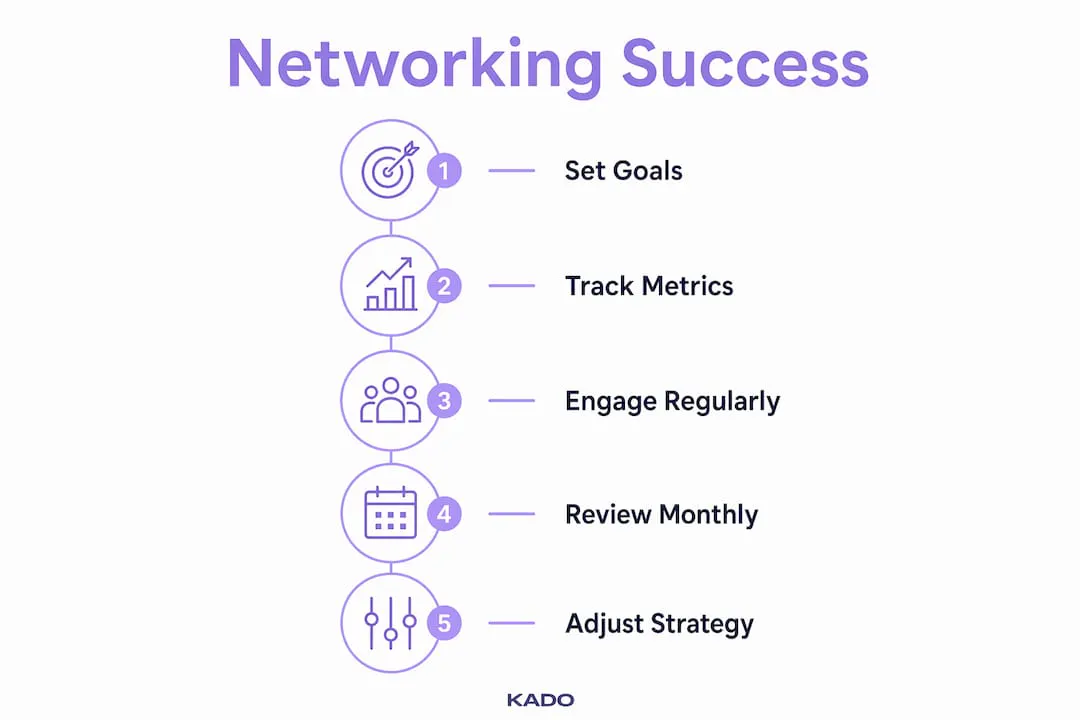
Tracking metrics like connection acceptance rate, engagement levels, and meaningful conversations is how you distinguish a networking strategy that works from one that feels busy but produces nothing. LinkedIn Analytics, personal CRM trackers, and even a simple Google Sheet can provide the data you need to make smart adjustments.
| Metric | What it tells you | Recommended tool |
|---|---|---|
Connection acceptance rate | Whether your targeting and messaging are resonating | LinkedIn Analytics |
Meaningful conversations per week | Whether connections are converting to real relationships | Personal CRM (Notion, Airtable) |
Referral opportunities generated | Whether your network is actively creating value | CRM tracker or Google Sheets |
Follow-up response rate | Whether your post-meeting outreach is landing | Email or LinkedIn inbox tracking |
Event ROI (meetings booked per event) | Whether your event selection and preparation are effective | Spreadsheet or event CRM |
Set goals that align with your specific professional objectives. A sales professional might target three referral introductions per month. A founder might target two meaningful investor conversations per quarter. Vague goals like “network more” produce vague results. Specific targets create accountability and make it obvious when a tactic needs to change.
Review your metrics monthly. If your connection acceptance rate drops below 30%, your targeting or messaging needs work. If meaningful conversations are high but referrals are low, you may be building rapport without creating enough clarity around what you do and what you need. Each metric points to a specific lever you can adjust.
Key takeaways
Effective networking in 2026 requires AI-augmented precision, a curated inner circle of 50 to 100 contacts, and consistent follow-through across both digital and in-person channels.
| Point | Details |
|---|---|
AI as a research tool | Use AI to detect trigger events and personalize outreach, not to automate the conversation itself. |
Quality over quantity | Maintain 50 deep relationships with a personal CRM rather than accumulating thousands of shallow contacts. |
Async tools scale relationships | Loom videos and voice notes let you sustain 200 relationships on the same time budget as 20 calls. |
Follow up within 48 hours | Researched, specific follow-ups sent within 48 hours of meeting someone capture the relationship at its warmest point. |
Measure what matters | Track connection acceptance rate, meaningful conversations, and referral opportunities monthly to refine your approach. |
Our take on where networking is actually heading
We have watched the conversation around professional networking shift dramatically over the past few years, and the 2026 version of this discussion is the most honest it has ever been. For a long time, the advice was to attend everything, connect with everyone, and let volume do the work. That approach produced large contact lists and very few real relationships.
What we see working now is almost the opposite. The professionals building the strongest networks are the ones who treat their contact list like a garden rather than a warehouse. They tend specific relationships with care and attention, and they are patient about it. They are not chasing every new platform or AI tool. They are using one or two tools well and staying consistent.
The role of AI in this is genuinely exciting to us, but we want to be direct about one thing: AI must reduce friction in research and follow-up, not replace the conversations that build trust. Every time we see a professional send an obviously automated message, we watch a relationship opportunity close before it opens. The technology is a multiplier of human effort, not a substitute for it.
The professionals we most respect in this space are the ones who give value consistently, show up in the same communities over months and years, and ask for very little until the relationship has real depth. That is not a 2026 insight. It is a timeless one that the best digital networking trends 2026 has surfaced simply make easier to execute at scale.
How KADO helps you put these practices into action
Building strong connections is only half the work. Organizing, following up, and tracking those relationships is where most professionals lose momentum.
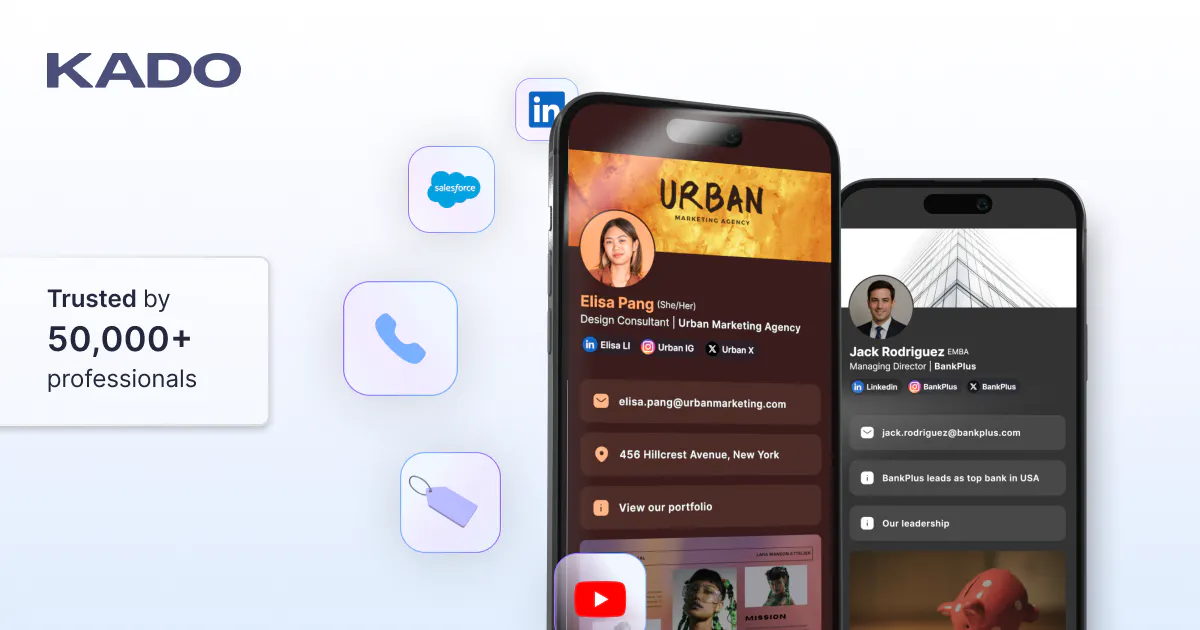
KADO is built for exactly this challenge. With KADO’s contact management tools such as their digital business cards, you can capture new contacts instantly via QR code or NFC, organize them with custom tags and notes, and automate follow-up reminders so no relationship goes cold. The platform integrates with CRM systems like Salesforce and HubSpot, so your networking activity feeds directly into your pipeline. For professionals who want to manage their connections on the go, KADO’s relationship management features give you a full view of every interaction in one place. It is the infrastructure that makes the practices in this article sustainable.
Frequently Asked Questions
How do I measure whether my networking strategy is working?
Track connection acceptance rate, meaningful conversations per week, and referral opportunities generated each month. If any metric stagnates for two consecutive months, adjust your targeting, messaging, or event selection before adding more volume.
How soon should I follow up after a networking event?
Follow up within 48 hours of meeting someone. Reference a specific detail from your conversation and include one piece of value to make the message stand out from generic post-event messages.
How does AI improve professional networking?
AI tools like Lessie monitor trigger events and personalize outreach, improving networking efficiency by 3 to 5 times compared to traditional methods. The key is using AI for research and reminders while keeping the actual conversations human.
What tools should I use to track my professional network?
Personal CRMs like Notion and Airtable are the most flexible options for tracking conversation history and contact context. LinkedIn Analytics works well for measuring outreach performance and engagement trends.
What is the most important networking best practice in 2026?
Prioritizing quality over quantity is the single most impactful shift you can make. Maintaining 50 deep, well-tracked relationships generates more referrals and opportunities than a contact list of thousands.