Torna alla lista dei post
What To Do After a Networking Event: The Follow-Up Playbook That Actually Works
Ultima modifica: March 27, 2026


You just walked out of a networking event with a pocketful of conversations, a head full of names, and maybe a stack of paper cards you'll never look at again. The energy was real. The connections felt promising. And somewhere between the commute home and Tuesday morning, most of it will evaporate.
Here's the uncomfortable truth: the event itself is not where professional relationships are made. It's where they're started. Everything that matters — the deal, the referral, the partnership, the job introduction — happens in what you do next.
The event follow up email is your first move. Get it right, and a five-minute conversation at a conference becomes something worth having. Get it wrong — or worse, skip it entirely — and you've paid for a ticket, given up a day, and come home with nothing.
This guide is your complete post-event playbook: how to sort your contacts, when to reach out, exactly what to write, and how to build a system that keeps working even when life gets busy.
The 48-Hour Window Nobody Talks About
Picture this: you meet someone at Web Summit or SXSW. You have a genuinely great conversation. They're exactly the type of person you've been trying to get in front of for months. You promise to "connect properly next week."
Nine days later, you send a message.
By that point, they've met hundreds of other people. They've flown home, caught up on email, and moved on. Your name rings a faint bell at best.
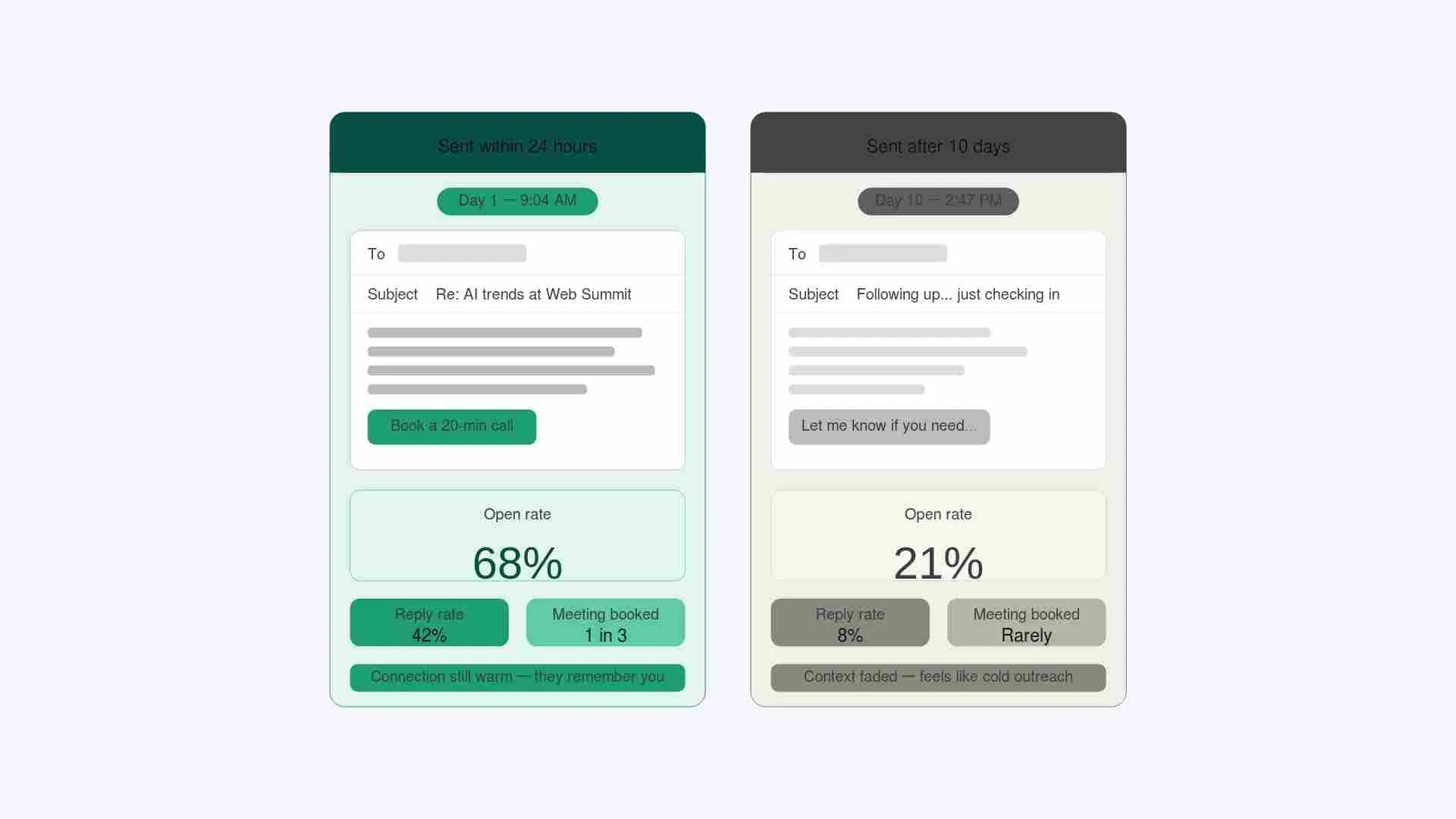
The 48-hour window is real. Memory degrades fast — and so does context. The follow-up email you send the morning after a networking event lands completely differently than the one you draft a week later. Early, it feels like a continuation of the conversation. Late, it feels like a cold outreach that happens to mention an event you both attended.
Speed isn't just courtesy. It's strategy.
Before You Write Anything: Sort Your Contacts That Same Evening
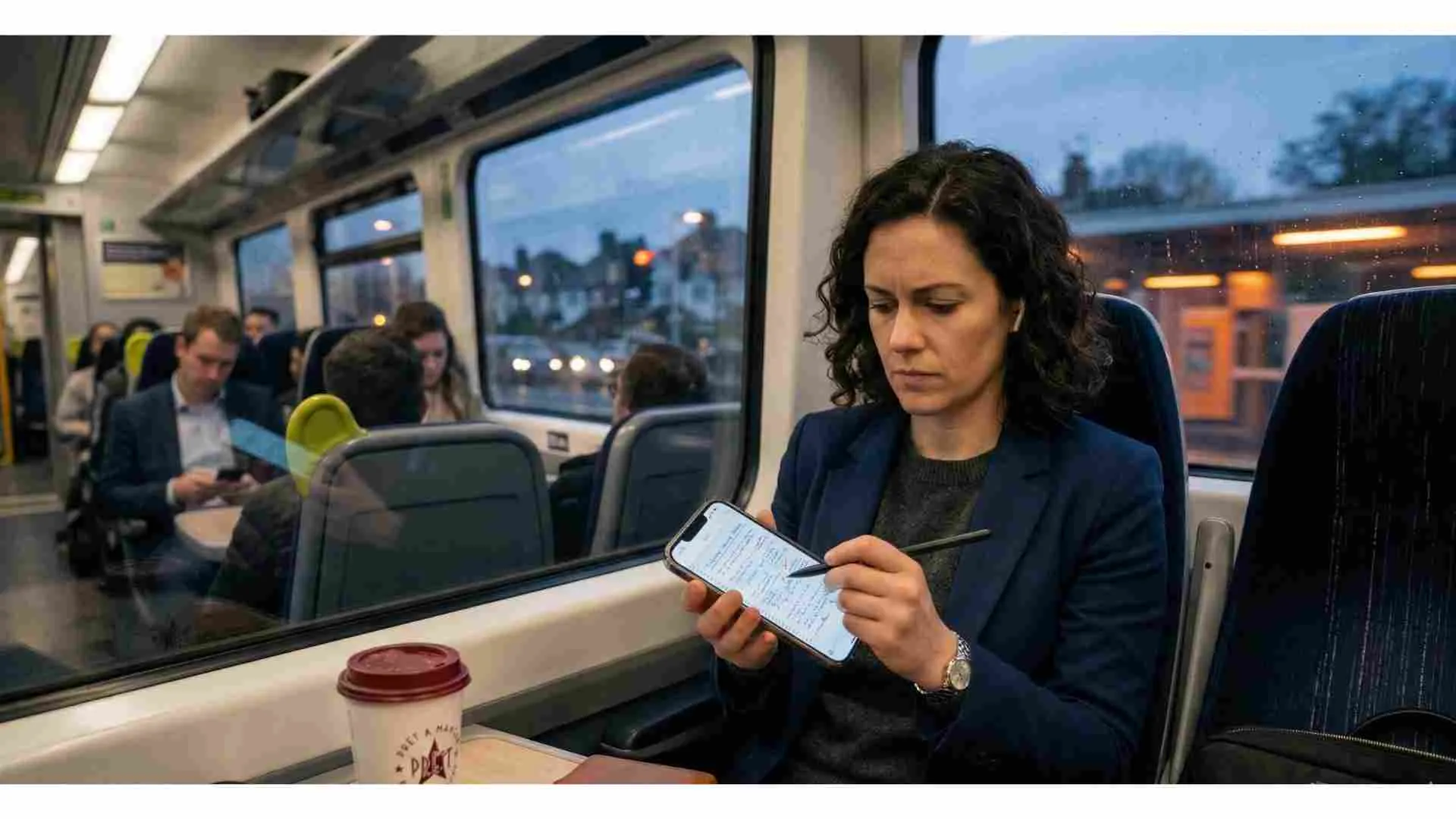
The worst time to think about who deserves a follow-up is Monday morning, when the week has already started pulling you in different directions. Do this the night of — on the train home, at the hotel bar, wherever you land.
You don't need anything elaborate. Three categories is enough:
Tier 1 — Follow up within 24 hours. These are the people where something real sparked. A potential client. A future collaborator. Someone who said "you should talk to my colleague about this" and actually meant it. These contacts get your full attention first.
Tier 2 — Follow up within 3 to 5 days. Good conversations, no immediate opportunity. Worth staying connected to, but no urgency.
Tier 3 — A LinkedIn connection and nothing more. Friendly exchanges that didn't go anywhere specific. Stay visible without investing email real estate.
Write Down What You Remember — Right Now
For every Tier 1 and Tier 2 contact, capture:
- The specific thing you talked about that they cared about most
- Any promise you made ("I'll send you that case study," "I'll introduce you to my colleague")
- One personal detail — a shared frustration, an upcoming trip, a project they're excited about
That detail becomes your subject line. That promise becomes your email structure. Without it, your follow-up is just another message that opens with "It was great meeting you at…" — which is exactly what everyone else sends.
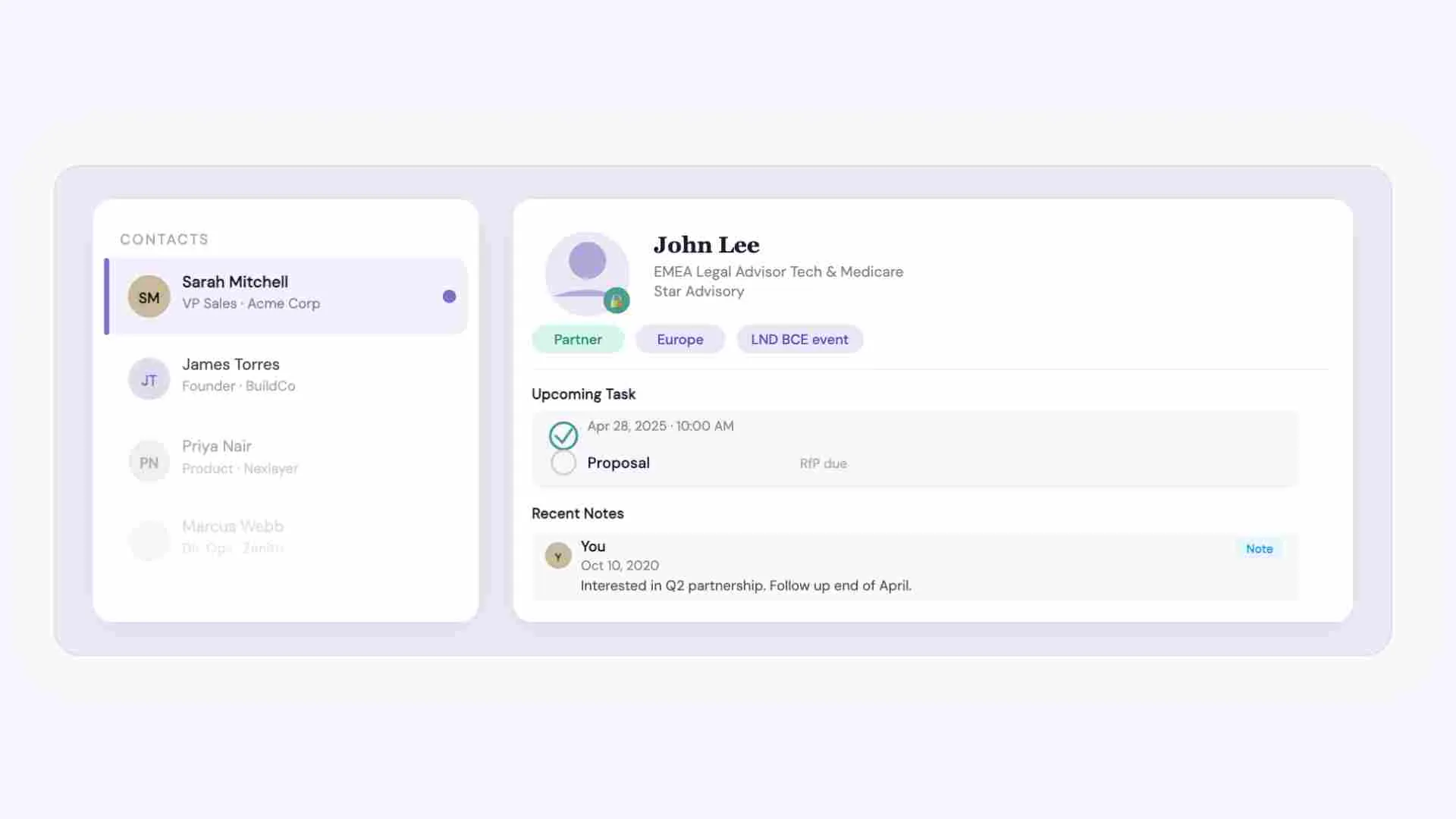
KADO makes this step significantly less painful. When you exchange digital business cards at the event, you can drop a note directly onto that contact — what you discussed, what you promised, how to prioritize them — so by the time you're home, the work is already done. No mystery stacks of paper. No fading memories three days later.
Post Event Email Examples: 5 Templates You Can Use Today
These aren't generic templates. Each one is built for a specific scenario you'll actually encounter — and each one is short enough that people will actually read it.
Template 1 — The Standard Follow-Up (Works for 80% of Cases)
Subject: [Specific thing you discussed] — great meeting you at [Event]
Hi [First Name],
Really enjoyed talking with you at [Event] — especially what you said about [specific topic]. I've been thinking about it since, and I think you're onto something with [brief reflection or point of agreement].
As I mentioned, here's [the resource / article / contact] I was telling you about: [link or attachment]
Would love to continue the conversation. Open to a quick call in the next couple of weeks? Happy to work around your schedule.
[Your Name] [Title] | [Company] [Digital card link]
Template 2 — When You Want to Book a Meeting
Subject: Following up — [Your Name] from [Event]
Hi [First Name],
Our conversation at [Event] was one of the highlights of the day — the way you framed [topic] gave me a completely different angle on something I've been working through.
I'd love to find 20–30 minutes to continue the conversation properly. Here's my calendar if you want to grab a time: [link]
No pressure if the timing isn't right — just keen to keep the exchange going.
[Your Name] [Title] | [Company]
Template 3 — Lighter Touch for Tier 2 Connections
Subject: Good meeting you at [Event], [First Name]
Hi [First Name],
Just a quick note to say it was great crossing paths at [Event]. I really enjoyed hearing about [specific thing they mentioned] — sounds like an interesting space to be in right now.
Sending a LinkedIn request your way too. Would love to stay in the loop on what you're building.
[Your Name]
Template 4 — Making an Introduction You Promised
Subject: The intro I mentioned — [First Name], meet [Name]
Hi both,
I promised [First Name] I'd make this intro, so here we go.
[First Name], [Name] is [one-sentence description]. [Name], [First Name] is doing [one-sentence description]. I think the overlap will be obvious the moment you start talking.
I'll leave you both to it.
[Your Name]
Template 5 — The Gentle Second Follow-Up
Subject: Re: [Original subject line]
Hi [First Name],
Circling back in case my last message got buried — completely understand if the timing isn't right.
Still happy to connect whenever it works for you. No rush.
[Your Name]
Send this one 5–7 days after your first email. If there's still silence after that, let it go. Two attempts is the professional standard — three starts to feel like pressure.
The LinkedIn Move (Do This at the Same Time)
Email is professional. LinkedIn is persistent — a connection request that gets accepted becomes a passive presence in someone's feed for years. Use both.
When sending the request, always include a note. The default "I'd like to add you to my professional network" is the networking equivalent of a form letter. Try this instead:
"Hi [Name] — loved our conversation at [Event] about [topic]. Looking forward to staying connected."
Two sentences. That's the difference between a name they recognize and a name they ignore.
The professionals who build real networks aren't just showing up to tech events in NYC or TechCrunch Disrupt or Dreamforce — they have a system running in the background when they leave.
The Mistakes That Kill Good Connections Before They Start
You can have a great event and still come home with nothing. Here's how it usually happens:
| Mistake | Why |
|---|---|
Waiting too long. | Ten days after the event, your window has largely closed for Tier 1 contacts. If you're not reaching out within 24–48 hours, the opportunity cost is real. |
Going generic | "Great meeting you!" is not a follow-up. It's a placeholder. If your email could have been sent to anyone at the event, it will be treated accordingly. |
Asking for too much, too soon. | A follow-up that jumps straight to a referral request, a full sales pitch, or a partnership proposal after one conversation is how you ruin a warm lead before it has a chance to go anywhere. |
Not delivering what you promised. | If you said "I'll send you that report" and you don't, you haven't just dropped the ball — you've demonstrated something about how you operate. And people notice. |
No next step. | "Let me know if you ever need anything" is not a call to action. Give people something easy and specific to respond to. |
For a broader look at how to approach events strategically — so you have better conversations to follow up on in the first place — see the ultimate networking event checklist and the pro tips to grow your professional network.
When You're Attending Events Back-to-Back
High-volume event seasons — conference circuits, trade show runs, startup weeks — create a different kind of problem. You're not following up after one event. You're following up after four events in two weeks, with 30 new contacts each time.
At that volume, the manual approach breaks down fast. Here's how to keep up:
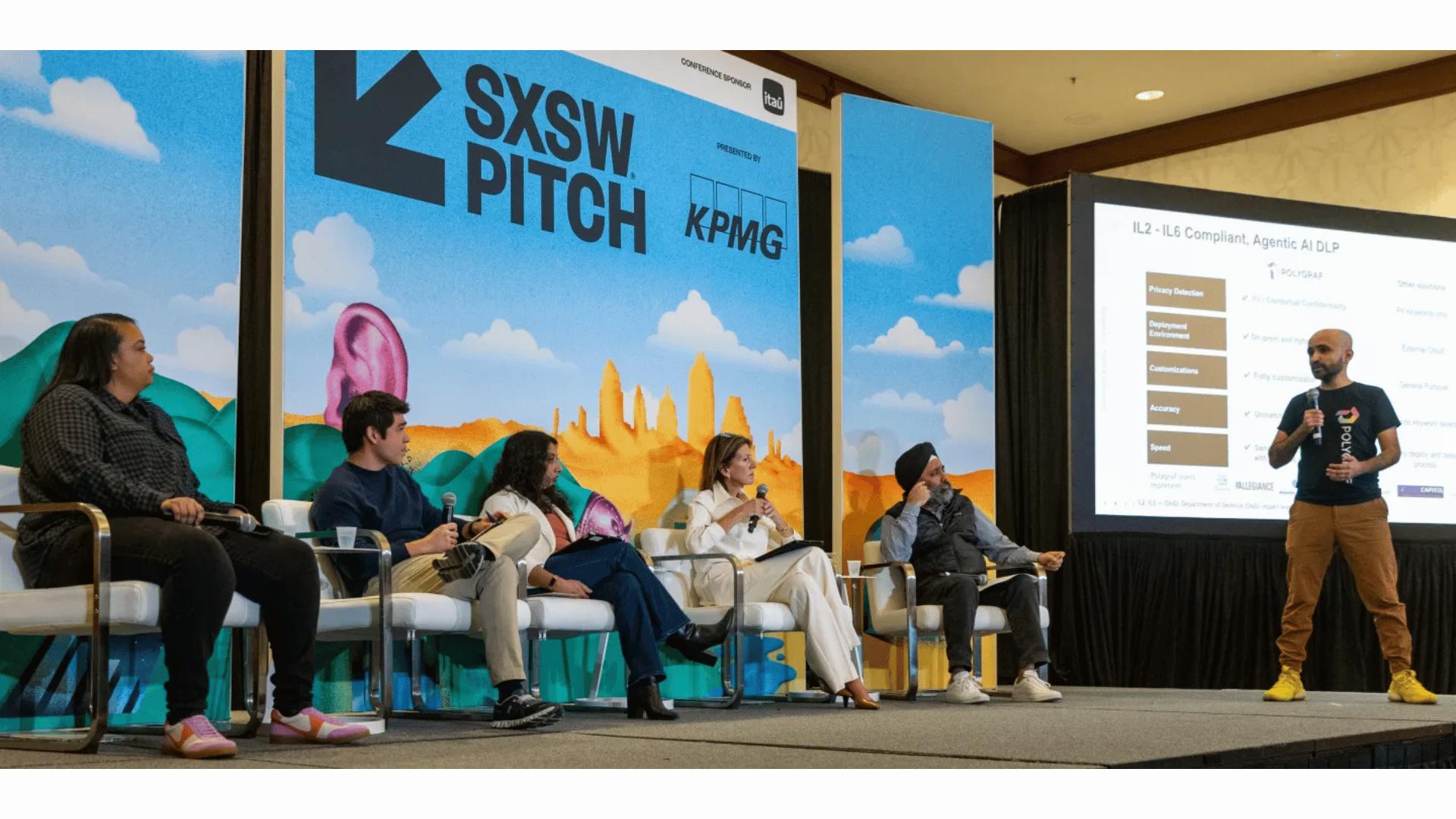
Capture contacts digitally at the event. Paper business cards are the original information black hole. If you're attending something like SXSW where the crowd numbers in the tens of thousands, getting everything into a digital format in real time isn't a luxury — it's the only way to avoid drowning afterward.
Write your follow-up notes immediately. One sentence per person while the conversation is still in your head. Do it on the train. Do it at the hotel bar. Don't wait until Monday.
Batch your outreach by tier. All Tier 1 emails go out first — same day or first thing the next morning. Tier 2 goes out a few days later. Tier 3 is a LinkedIn sweep.
Set a recurring calendar block. Forty-five minutes, the week after every major event. Protected time to catch anything that slipped. Call it whatever you want, just don't skip it.
Final Thoughts
The professionals who build real, lasting networks aren't the loudest people in the room. They're the ones with a system for what happens after they leave it.
A well-timed, specific event follow up email isn't just polite — it's the mechanism that converts a five-minute conversation into something worth having. Use the templates in this guide, personalize the details that make them feel human, and install the follow-up habit that most people intend to build but never actually do.
The conversation at the event was the easy part. The follow-through is what separates the professionals who leave with real connections from the ones who leave with a pile of cards and good intentions.
Domande Frequenti
How soon should I send a follow-up email after a networking event?
Within 24 hours for your most important connections — no exceptions. Memory fades fast on both sides, and an email sent the next morning reads like a genuine continuation of the conversation. One sent nine days later reads like a cold outreach with a vague backstory. For lighter connections, 3–5 days is fine. After a week, you've lost the warm window for most Tier 1 contacts.
What should a good post-event email actually include?
The best post-event emails are specific, short, and end with one clear ask. Reference something real from the conversation — not just the event name. Deliver any value you promised. Close with a low-friction next step: a brief call, a reply, or a calendar link. Anything over 150 words risks getting skimmed past the trash folder. If you're not sure where to start, KADO lets you attach notes and context directly to each contact the moment you meet them — so by the time you're home, the raw material for a personalized, specific follow-up email is already sitting there waiting.
How does KADO help with post-event follow-up?
KADO is a digital business card and contact management platform built for exactly this gap. At the event, you share your card instantly and capture new contacts with notes and tags attached — no paper, no data entry later, no guessing who someone was three days after the fact. Back home, your contacts are already organized, searchable, and ready to push into your CRM via Zapier. It eliminates the space between "I met someone great today" and "now what?" — which is where most networking ROI quietly disappears. Learn more about connecting KADO to your CRM.
Is it better to follow up by email or LinkedIn message?
Email is the stronger channel for meaningful connections — it's more direct, less cluttered, and signals that you put in deliberate effort. LinkedIn works well as a secondary touchpoint and is ideal for lighter connections where you don't have an email address. For Tier 1 contacts, use both: email first, LinkedIn connection request sent at the same time. The combination creates two points of recognition without tipping into aggressive territory.