Retour à la liste des articles
Why Investor Relations Depend on Strong Contact Management
Dernière modification: March 15, 2026


If you've ever wondered what is investor relations and why some companies seem to raise capital effortlessly while others struggle — the answer usually isn't just about the pitch deck. It comes down to relationships, and more precisely, the systems used to manage them.
Investor relations (IR) is the strategic function that bridges a company and its financial stakeholders — from institutional fund managers and venture capitalists to angel investors and analysts. But managing those stakeholders at scale is where many IR professionals fall short. Without a disciplined approach to contact management, even the best IR strategy falls apart.
This article explains what investor relations actually involves, why contact management is its silent engine, and what tools and habits the most effective IR teams use to stay ahead.

What Is Investor Relations?
Investor relations is a corporate function responsible for managing communication between a company's leadership and its financial stakeholders. At public companies, this is typically a dedicated department. At startups and growth-stage companies, it's often a founder or CFO wearing multiple hats.
The goal of investor relations is to ensure that investors — current and prospective — have an accurate, timely, and positive understanding of the company's performance, strategy, and outlook.
Core Responsibilities in Investor Relations
IR professionals typically handle:
| Core Responsibilities | More details |
|---|---|
Stakeholder communication | earnings calls, investor updates, shareholder letters |
Capital raising support | coordinating roadshows, managing LP pipelines |
Relationship maintenance | regular touchpoints with existing investors |
Financial storytelling | Translating complex financials into a clear narrative |
Compliance and transparency | especially for public companies under SEC regulation |
What unites all of these activities is the need to track people, interactions, and commitments — which is exactly where contact management becomes critical.

Why Contact Management Is the Foundation of Investor Relations
Think about what effective investor relations actually requires day-to-day. You need to know who your investors are, when you last spoke with them, what they care about, and what you promised to follow up on. Then you need to repeat that across dozens or hundreds of relationships — simultaneously.
Without strong contact management infrastructure, you're flying blind.
1. Investors Expect to Be Remembered
One of the fastest ways to damage an investor relationship is to forget something they told you. If a fund manager mentioned they're focused on Series B in HealthTech, and you call them three months later pitching a pre-seed SaaS round, you've wasted their time and signaled that you don't listen.
Good contact management means capturing context at every interaction — their current investment thesis, stage preferences, portfolio conflicts, and any personal details that can warm a cold call. Notes taken immediately after a meeting are infinitely more useful than trying to reconstruct a conversation two weeks later.
2. IR Is a Long Game
Most investor relationships take 12 to 36 months to convert into a commitment. During that time, the IR professional needs to maintain consistent, relevant communication without overwhelming the contact. Too frequent, and it becomes noise. Too infrequent, and the relationship goes cold.
A well-organized contact system lets you set appropriate follow-up cadences, track communication history, and flag when a relationship has been neglected. This is the kind of discipline that compounds over time — and it's nearly impossible to maintain manually across a large investor network.
3. Fundraising Rounds Move Fast
When a fundraising window opens, the companies that close quickly are the ones with warm pipelines already built. That means contacts are up to date, introductions have been made, and the IR team can move from "nurturing" to "closing" without scrambling.
Teams that neglect contact management during quiet periods often find themselves rebuilding relationships from scratch when they most need them — a painful and avoidable problem. Read more about building strong pipelines in our guide for dealmakers.

Common Contact Management Mistakes in Investor Relations
Even experienced IR professionals make these errors. Knowing them is the first step to avoiding them.
Relying on Email as a CRM
Email inboxes are search tools, not relationship management systems. Yes, your email history tells you what was said — but it doesn't tell you who needs a follow-up, how long it's been since you last spoke, or what was agreed in a meeting. Many IR professionals lose investor relationships simply because the contact "fell through the inbox."
Not Capturing Notes in Real Time
Context fades fast. If you meet five investors at a conference and wait until the following week to log your notes, you've already lost most of the nuance. The specifics that separate a personalized follow-up from a generic one — a shared contact, a comment about market conditions, a concern about your business model — disappear quickly.
Tools that let you capture notes immediately after a meeting, even by voice, are especially valuable for IR teams that travel frequently. Professionals attending investor conferences often use platforms like KADO to record notes and tag contacts on the spot, so nothing gets lost between the event and the office.
Siloed Contact Data
In many IR teams, investor contacts live in one person's email, another's spreadsheet, and a third's LinkedIn. When someone leaves the company or transitions off the account, institutional relationship knowledge walks out the door with them.
Shared, centralized contact systems protect the company from this kind of knowledge loss — and they make onboarding new team members far faster. KADO's relationship management platform is built specifically to solve this problem, giving teams a single shared view of every contact.
Inconsistent Tagging and Segmentation
Not every investor needs the same communication. A strategic angel who's known the founder for five years needs a different update than a new institutional contact who just entered the funnel. Without proper segmentation, IR teams default to one-size-fits-all messaging that fails to resonate with anyone.
Building a Contact Management System for Investor Relations
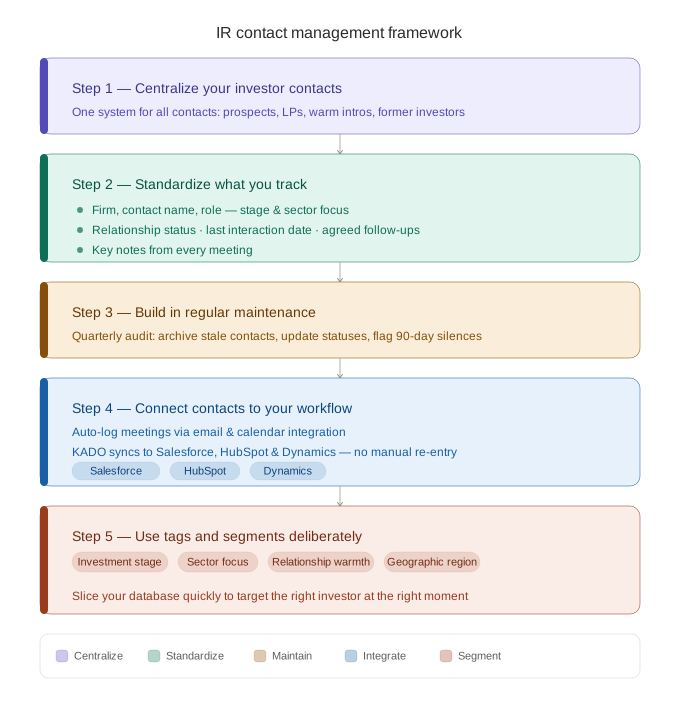
A strong IR contact management system doesn't have to be complex. It does have to be consistent. Here's a practical framework:
Step 1: Centralize Your Investor Contacts
All investor contacts — prospects, current LPs, warm intros, former investors — should live in one system accessible to everyone on the IR team. Whether that's a dedicated CRM like Salesforce or HubSpot, or a purpose-built relationship management platform, the key is that it's a single source of truth.
Step 2: Standardize What You Track
Decide upfront what information matters most for your IR function. At minimum, track:
- Firm name, contact name, role
- Stage and sector focus
- Current relationship status (prospect / intro made / meeting scheduled / active diligence / committed)
- Last interaction date
- Key notes from each meeting
- Agreed follow-ups and deadlines
Step 3: Build in Regular Maintenance
A contact database is only as good as the last time it was updated. Assign someone to audit the database quarterly — archiving contacts who are no longer relevant, updating relationship statuses, and flagging contacts who haven't been touched in over 90 days.
Step 4: Connect Your Contact System to Your Workflow
The best contact management systems remove friction from data entry. Integration with email and calendar means that meetings and communications are logged automatically. CRM integrations ensure that when a contact is captured at an event, it flows into the right pipeline without manual re-entry.
KADO, for example, integrates with Salesforce, HubSpot, and Microsoft Dynamics — so investor contacts captured via digital business card at a roadshow event sync directly into the IR pipeline with no manual cleanup.
Step 5: Use Tags and Segments Deliberately
Tag contacts by investment stage, sector focus, relationship warmth, and geographic region. This lets you slice your database quickly when you need to target a specific audience — for instance, when you're sending an update that's only relevant to existing LPs, or when you're doing initial outreach to a new market.
The Role of Digital Tools in Modern Investor Relations
The IR function has modernized significantly over the past decade. Investor decks are shared via secure links, not printed. Video calls have replaced most in-person roadshow meetings. And the expectation for speed and personalization in investor communication has increased dramatically.
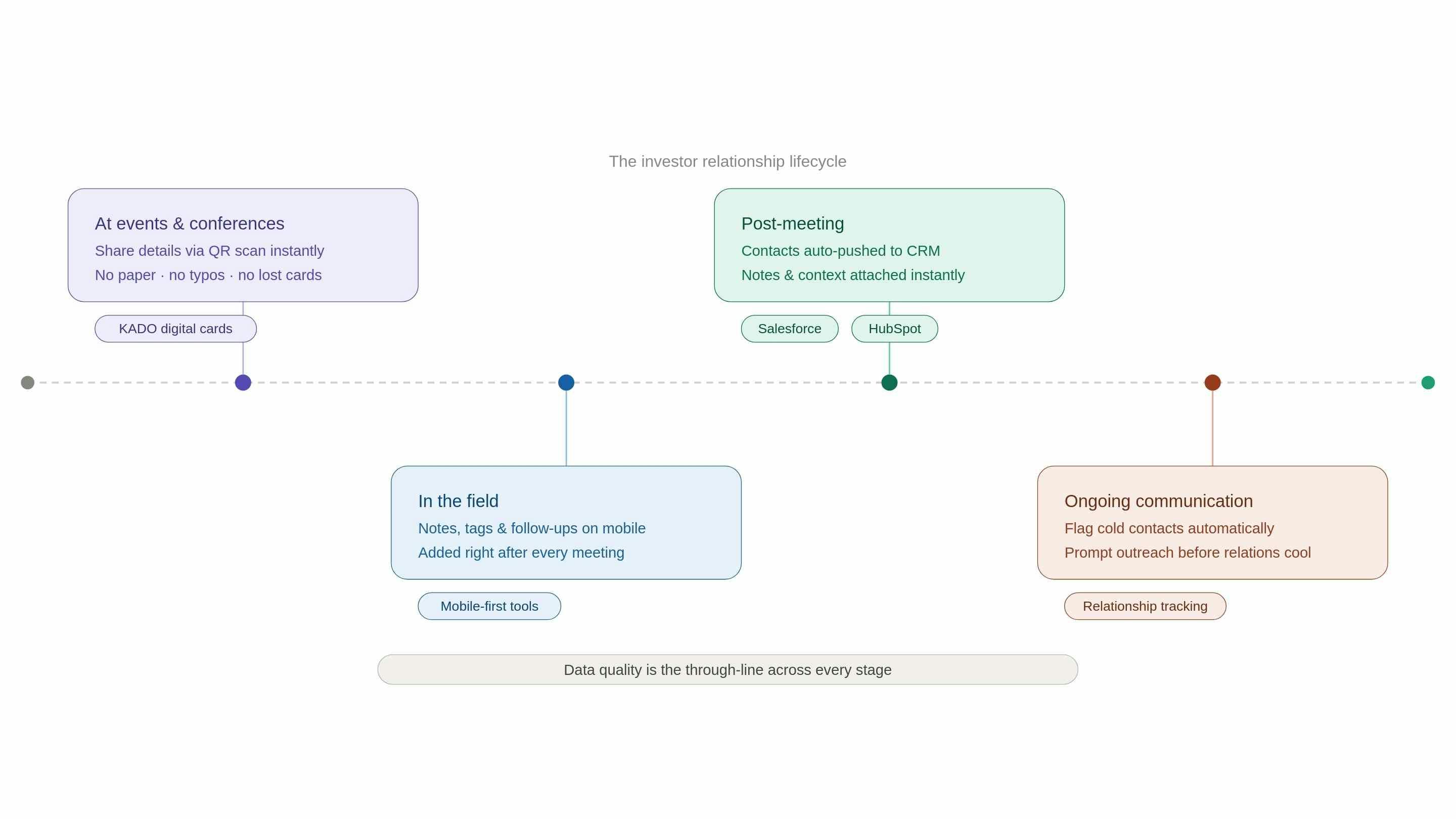
Digital tools now cover every stage of the investor relationship lifecycle:
At events and conferences: Digital business card platforms let IR professionals share their details instantly and capture investor contacts with a QR code scan — no paper, no typos, no cards lost at the bottom of a bag. For teams attending large-scale investor events, check out how KADO approaches event networking.

In the field: Mobile-first contact management tools allow notes, tags, and follow-up tasks to be added immediately after a meeting, even without internet access.
Post-meeting: CRM integrations push captured contacts into the right pipeline stage automatically, with notes and context attached.
For ongoing communication: Email sequences and relationship tracking tools flag when a key investor contact hasn't been engaged recently, prompting timely outreach before the relationship cools.
The through-line across all of these tools is data quality. The more structured and current your contact data, the more effective every other part of your IR strategy becomes.
Investor Relations at Different Company Stages
Contact management needs scale with the complexity of the IR function. Here's how it typically evolves:
Pre-seed / Seed: IR is almost entirely done by the founder. A lightweight CRM or even an organized spreadsheet can work — as long as it's maintained. The most important habit at this stage is logging every investor conversation and its outcome, however small.
Series A / B: The network grows faster than one person can manually manage. A proper CRM becomes essential. Tagging, segmentation, and shared access become priorities. Some companies hire a dedicated IR manager at this stage. Teams of all sizes are increasingly turning to enterprise-grade digital business card tools to standardize how contacts are captured and shared.
Growth stage and beyond: IR functions typically include dedicated staff, investor portals, and structured reporting. The contact database may include hundreds of LPs, analysts, and prospective institutional investors. Integration between tools — CRM, email, event platforms — becomes critical for maintaining data integrity at scale.
The tools and discipline built at the early stages compound enormously. Founders who invest in good contact management habits from the first raise typically find subsequent rounds significantly easier — not because they got lucky, but because they kept the relationships warm.
Final Thoughts
Investor relations is ultimately a people business. Deals get done because someone picked up the phone at the right time, remembered a detail from a meeting six months ago, or maintained a relationship through a down cycle when others went quiet.
None of that happens by accident. It happens because someone built the systems and habits to make it possible — and contact management is the foundation those systems are built on.
Whether you're a first-time founder managing a small angel network or an IR director overseeing a complex institutional pipeline, the principle is the same: the quality of your contact data determines the quality of your investor relationships. Invest in it early, maintain it consistently, and it will pay dividends long before the next raise opens.
Related reading:
- Financial Advisory & Digital Business Cards
- Relationship Management with KADO
- KADO Integrations: Salesforce, HubSpot & More
- Best Digital Business Cards for Enterprise in 2026
- Best Digital Business Cards for Teams in 2026
External sources:
Foire aux questions
What is investor relations and why does it matter?
Investor relations is the strategic communication function between a company and its financial stakeholders — investors, analysts, and potential capital providers. It matters because how a company manages these relationships directly affects its ability to raise capital, maintain investor confidence, and build a strong reputation in the financial community. NIRI provides extensive resources on IR best practices for professionals at every level.
What tools are commonly used for investor relations contact management?
Common tools include Salesforce, HubSpot, and Microsoft Dynamics for CRM. For contact capture at events, digital business card tools like KADO are increasingly used by IR teams. Some companies also use dedicated investor portal software for LP communication and reporting. See KADO's full list of CRM integrations for more detail.
Can contact management software integrate with investor portals?
Many CRM and contact management platforms offer integrations with investor portals and data rooms through API connections or third-party tools like Zapier. KADO, for example, connects with Salesforce, HubSpot, and Microsoft Dynamics, allowing investor contacts captured at events to flow directly into existing IR workflows. Explore KADO's full integrations page for a complete overview.
Do startups need a formal investor relations function?
Not always a formal department, but yes — every company that has taken on external capital should have a clear process for investor communication. At minimum, that means regular updates, a maintained contact database, and a structured approach to handling investor inquiries.