Retour à la liste des articles
Paperless networking: streamline contacts and lead generation
Dernière modification: May 7, 2026


Most professionals discard paper business cards, leading to lost contacts and delayed follow-ups. Paperless networking uses digital tools like QR codes and CRM integration to enhance contact management, engagement, and data accuracy. Adopting digital cards streamlines relationships, provides real-time analytics, and strengthens brand perception in modern business environments.
Most professionals walk away from conferences, client meetings, and industry events with a stack of paper business cards that end up buried in a drawer or scattered across a desk. Contacts get lost. Follow-ups get delayed. Leads go cold. The traditional approach to networking was never designed for the speed and scale of modern business, and the gap between how we connect and how we manage those connections keeps widening. Paperless networking closes that gap by replacing physical cards and manual processes with digital tools that capture, organize, and activate every contact you make.
Key Takeaways
| Point | Details |
|---|---|
Digital first impression | Paperless networking helps you create a memorable, modern connection with every contact. |
Faster follow-ups | You can share and organize contact details instantly, reducing lost opportunities. |
Eco-friendly alternative | Digital cards reduce waste and recurring costs compared to paper cards. |
Better data management | Integrations with CRM and analytics ensure every lead is captured and nurtured automatically. |
Easy industry adoption | Professionals in any industry can benefit from customizable digital card options. |
Understanding paperless networking
With new technology transforming every aspect of work, let’s define what paperless networking really means in practice.
Paperless networking replaces traditional business cards with digital tools, allowing professionals to exchange contact information via smartphones, QR codes, or email. It is not simply downloading an app or scanning a card with your phone camera. It is a complete shift in how contact data moves between people and systems.
At its core, paperless networking includes several interconnected tools and methods:
- Digital business cards that live on your phone and can be shared via QR code, NFC tap, or a simple link
- Virtual contact managers that automatically organize every new connection you make
- QR code sharing that lets you exchange information in seconds without touching a device
- CRM integrations that push new contacts directly into your sales or marketing pipeline
One common misconception is that going paperless means sacrificing personalization. That is simply not true. Digital cards can include your photo, brand colors, embedded video, social links, and even a contact capture form. Another misconception is that paperless networking only works in tech-forward industries. In reality, it fits every sector, from financial services to real estate to healthcare.
The real advantage of paperless networking is not just convenience. It is data reliability. Every contact you exchange digitally is instantly stored, searchable, and ready to act on. No typos from manual entry, no lost cards, no outdated phone numbers sitting in a stack of paper.
The shift to digital also removes friction from the follow-up process. When contact data flows automatically into your systems, you spend less time on administrative tasks and more time building actual relationships.

How paperless networking transforms professional connections
Now that you understand what paperless networking is, let’s see how it changes the way you build and manage professional relationships.
The difference between paper and digital becomes most obvious when you trace a single connection from first meeting to closed deal. Here is how that journey looks with a paperless approach:
- First contact: You meet a prospect at an industry event. Instead of handing over a paper card, you share your digital card via QR code. They scan it in under five seconds.
- Instant capture: Their contact details are captured automatically through a contact form embedded in your card. No manual entry required on either side.
- Automatic organization: The new contact syncs directly to your contact manager tools, tagged by event, date, and industry.
- CRM integration: The contact is pushed to your CRM, triggering an automated follow-up sequence within minutes of the meeting.
- Analytics tracking: You can see when they viewed your card, what links they clicked, and how many times they returned to your profile.
- Ongoing engagement: You update your card with a new offer or resource, and everyone who has your card sees the update automatically.
Compare that to the paper card process: hand over a card, hope they keep it, manually type their details into your phone or CRM days later, and send a follow-up that arrives too late to feel timely. Digital business cards for consultants and other professionals provide a secure, easily updated, and universally accessible way to share credentials and connect, which is exactly what modern relationship-building requires.
Studies consistently show that the majority of paper business cards are thrown away within a week of being received. The ones that survive often contain outdated information by the time someone tries to use them. With digital cards, your information is always current, and the connection never goes cold simply because a card got lost.
Pro Tip: Connect your digital business card platform directly to your CRM from day one. When new contacts flow in automatically, you can trigger personalized follow-up sequences immediately, which dramatically increases response rates compared to manual outreach days after the event.
The speed advantage is significant. A professional who attends three events per month and collects 20 contacts at each event spends hours on manual data entry with a paper-based system. A paperless setup eliminates that entirely, freeing up time for actual selling, advising, or relationship development.
Digital vs. traditional business cards: A side-by-side comparison
With these new capabilities, it’s important to compare digital versus traditional networking tools side by side.
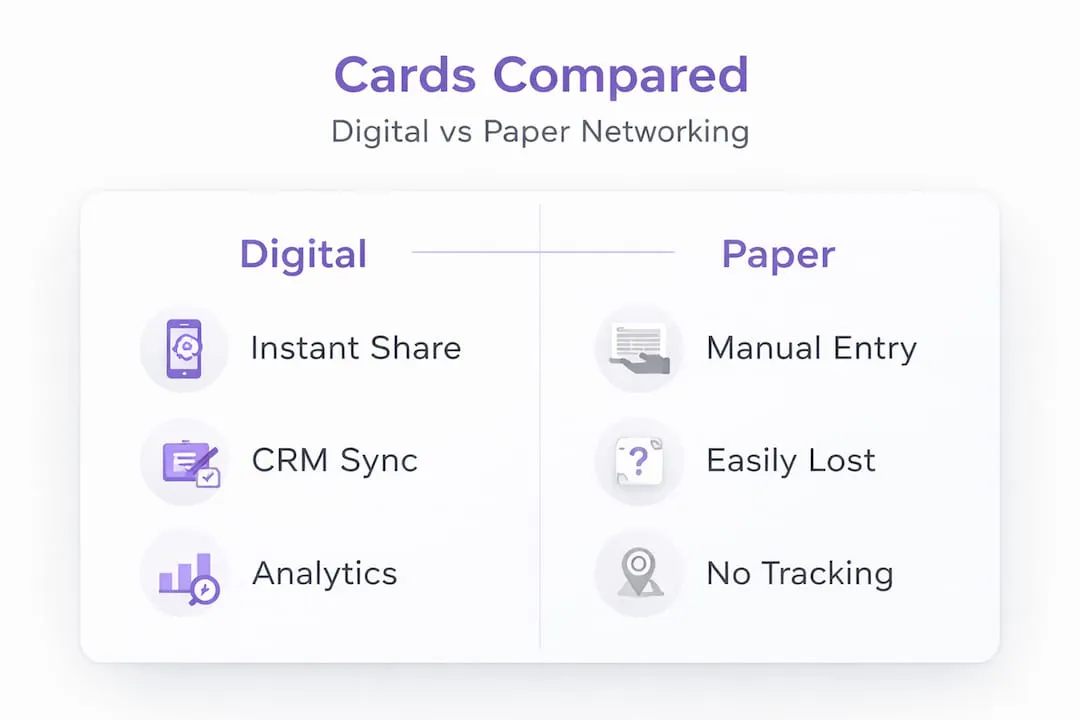
Digital cards offer real-time updates, analytics, and eco-friendly alternatives compared to traditional cards. The table below makes the differences concrete:
| Feature | Digital business cards | Traditional paper cards |
|---|---|---|
Update information | ✅ Instant, real-time updates | ⚠️ Requires reprinting |
Sharing method | ✅ QR code, NFC, link, email | ⚠️ Physical handoff only |
Analytics | ✅ Views, clicks, engagement data | ❌ No tracking available |
CRM integration | ✅ Automatic sync | ❌ Manual entry required |
Cost over time | ✅ Low, no reprinting | ⚠️ Recurring print costs |
Eco-friendliness | ✅ Zero paper waste | ❌ Paper and ink waste |
Personalization | ✅ Video, links, branding | ⚠️ Limited to print design |
Durability | ✅ Never damaged or lost | ⚠️ Easily lost or damaged |
Compliance and security | ✅ Encrypted, role-based access | ❌ No data controls |
Paper cards fail in specific, predictable situations. Understanding when they break down helps you see exactly where digital fills the gap:
- High-volume events: Handing out 50 cards at a trade show is manageable. Following up on 50 manual entries is not.
- Remote or hybrid meetings: You cannot hand someone a paper card over a video call.
- Role or title changes: Every time your information changes, your existing cards become inaccurate.
- International contacts: Paper cards in different languages or formats create confusion and data loss.
- Regulated industries: Paper cards offer zero security and compliance controls, which is a real liability in finance, pharma, or legal settings.
Pro Tip: If you attend events where lead generation volume is high, paperless tools are not just more convenient, they are measurably more effective. The ability to capture, tag, and follow up with 50 contacts in the same time it used to take to enter 5 manually is a genuine competitive advantage.
The environmental case is also worth noting. The global business card industry produces billions of cards annually, the vast majority of which are discarded quickly. Switching to digital removes your team’s contribution to that waste entirely, which increasingly matters to clients and partners who prioritize sustainability.
How to start with paperless networking
If you’re convinced paperless networking is the way forward, here’s how to transition quickly and efficiently.
With a digital platform, professionals across industries can set up, customize, and start sharing their credentials in minutes. The process does not require technical expertise or a long onboarding period. Here is a practical framework for getting started:
- Choose a provider: Look for a platform that offers digital card creation, contact capture, CRM integration, and enterprise-grade security. Evaluate whether they offer interactive product demos so you can test the experience before committing.
- Set up your digital card: Add your name, title, company, contact details, photo, and brand colors. Embed links to your LinkedIn, website, or a specific landing page. Include a contact capture form so new connections can share their details directly.
- Integrate with your contact manager and CRM: Connect the platform to your existing tools. Most modern digital card platforms support integrations with Salesforce, HubSpot, and other major CRMs out of the box.
- Train your team: Start with a small pilot group, ideally your most active networkers or sales team members. Gather feedback, refine the setup, and then roll out to the broader organization.
- Share and iterate: Begin sharing your card at every meeting, event, and digital touchpoint. Monitor analytics to see which contacts engage most, and use that data to prioritize follow-ups.
The table below shows how different industries use paperless networking in practice:
| Industry | Primary use case | Key benefit |
|---|---|---|
Financial services | Client onboarding and advisor introductions | Compliance-ready contact capture |
Pharma and life sciences | Rep-to-physician networking | Secure, regulated data sharing |
Energy and utilities | Partner and vendor relationship management | Scalable team deployment |
Real estate | Open house and buyer lead capture | Instant follow-up automation |
Consulting | Proposal and credential sharing | Always-current contact details |
Legal | Client intake and referral tracking | Encrypted contact management |
Privacy and compliance concerns come up often, especially in regulated industries. The good news is that reputable platforms address these directly with encrypted storage, role-based access controls, and audit trails. If your organization operates under GDPR, HIPAA, or similar frameworks, look for a vendor that explicitly supports those requirements and can provide documentation.
Piloting with a small team first is one of the most effective adoption strategies we have seen. It reduces resistance, surfaces real-world friction points before a full rollout, and gives you internal advocates who can champion the tool to their peers.
What most professionals still miss about paperless networking
Most articles about paperless networking focus on the basics: set up a digital card, share it via QR code, save some paper. That is useful, but it barely scratches the surface of what this technology actually enables.
The feature that most professionals overlook is analytics. When someone scans your digital card, you can see when they viewed it, how long they spent on it, which links they clicked, and whether they returned. That is intelligence you simply cannot get from a paper card. It tells you who is genuinely interested, which means you can prioritize your follow-ups based on actual engagement rather than guesswork.
Secure digital networking tools offer advanced privacy, integration, and compliance features that traditional cards cannot match. This matters enormously in enterprise environments where data security in digital cards is not optional. Role-based access means your team can share company-branded cards without exposing sensitive backend data. Encrypted storage means contact information is protected from the moment it is captured.
There is also a brand perception dimension that rarely gets discussed. When you hand someone a paper card in 2026, it signals something about how your organization operates. It suggests manual processes, outdated systems, and a reactive approach to technology. When you share a polished digital card with embedded media, real-time updates, and a seamless contact capture experience, it signals the opposite. Your networking tool is part of your brand identity, whether you intend it to be or not.
The professionals who wait to switch are not just losing efficiency. They are actively creating a perception gap between themselves and competitors who have already modernized. The demand for secure, integrated networking solutions is growing fast, and the organizations that adopt early build institutional knowledge and workflow habits that are hard to replicate later.
We believe the real value of paperless networking is not the card itself. It is the system it connects to. A digital card that feeds clean data into a CRM, triggers automated follow-ups, and gives you engagement analytics is a lead generation tool. A paper card is just a piece of paper.
Get started with the best digital business card solution
To put all these best practices to work, leveraging an enterprise-ready solution can make all the difference.
KADO makes it straightforward for professionals to move from paper-based networking to a fully digital, integrated system. Whether you work in financial services, consulting, real estate, or any other field, KADO offers digital cards for any industry with customizable branding, CRM integration, and enterprise-grade security built in.
If you are ready to see how it works for your specific role or organization, you can request a demo and get a tailored walkthrough of the platform. For professionals in financial services specifically, KADO offers dedicated solutions for financial advisors designed to meet the compliance and relationship management demands of the industry. The setup takes minutes, and the impact on your networking efficiency is immediate.
Foire aux questions
What exactly is paperless networking?
Paperless networking is the process of exchanging contact information and nurturing relationships entirely through digital platforms instead of physical business cards. It uses tools like digital business cards, QR codes, and CRM integrations to replace manual, paper-based contact exchange.
How do digital business cards improve lead generation?
They allow instant sharing, organization, and integration with CRM systems, which can greatly increase follow-up rates and data accuracy. Digital business cards provide professionals with a secure, easily updated, and universally accessible way to share credentials and connect.
Are digital business cards secure for professional use?
Yes, modern solutions include privacy, compliance, and security controls that are often superior to traditional cards. Secure digital networking tools offer advanced privacy, integration, and compliance features that traditional cards simply cannot match.
Can I use digital cards in any industry?
Digital business cards are suitable for all industries, with customizable options for specialized professional roles. Digital cards for every industry are available with features tailored to the specific needs of sectors like finance, legal, pharma, and real estate.
How do I get started with paperless networking?
Choose a provider, set up your digital card, integrate with your contact manager, and share with colleagues and contacts. With a digital platform, professionals across industries can set up, customize, and start sharing their credentials in minutes.