Retour à la liste des articles
Branding Tips for Real Estate Agents in 2026
Dernière modification: May 27, 2026


Effective real estate branding starts with building a strong digital foundation through optimized profiles and consistent NAP citations. Once established, agents should develop a simple visual identity, including a logo and cohesive color scheme, to enhance memorability and professionalism. Prioritizing digital signals and content over visual polish ensures long-term recognition, trust, and lead generation.
Every real estate agent has a logo. Far fewer have an actual brand. In a market where buyers and sellers Google you before they ever call, the branding tips for real estate agents that actually move the needle go well beyond color palettes and headshots. Effective real estate branding strategies require a deliberate sequence: build your digital foundation first, polish your visual identity second, and then lock in consistency across every touchpoint. This guide walks you through exactly that, with no fluff and no steps you already know.
Key takeaways
| Point | Details |
|---|---|
Digital entity comes first | Optimize your Google Business Profile and NAP citations before investing in visual design. |
Own your digital platforms | A personal website and domain protect your brand equity through any brokerage change. |
Visual consistency builds trust | Limit your palette to two or three colors and apply them uniformly across every channel. |
Consistency drives recognition | Branded templates and content calendars keep your presence disciplined and professional. |
Sequence determines ROI | Agents who build digital signals first and visual polish second get discovered and remembered. |
1. Start with the “Google yourself” test
Before spending a dollar on design, search your own name and your city plus specialty. What comes up? If the answer is a brokerage directory listing you didn’t set up, a LinkedIn profile with a five-year-old photo, or nothing at all, you have a foundation problem. Ignoring the digital entity layer results in great design assets that are invisible to the clients searching for you online.
This test is your branding baseline. It tells you where you actually live in the digital world, not where you think you live. Run it on Google, Bing, and in a private browser so you see what a stranger sees. Repeat it monthly once you start making improvements.
2. Build your Google Business Profile before anything else
Your Google Business Profile (GBP) is the single highest-leverage, zero-cost branding asset you own. A fully optimized GBP gets you into the local map pack, generates direct calls, and signals credibility to every potential client before they visit your website. Fill in every field: categories, service areas, business hours, and a keyword-rich description. Upload photos of yourself, your team, and the neighborhoods you serve.
The timing of your review requests matters more than most agents realize. Asking for a review the day of closing, when emotions are high but the client is exhausted, often produces silence. A personalized email sent three to five days post-closing generates far better response rates. Make it specific: mention the address, the challenge you solved, and give them a direct link.
Pro Tip: Set a calendar reminder to add two new GBP photos every week. Fresh visual content is one of the signals Google uses to rank profiles in the local pack.
3. Lock down NAP consistency across every directory
NAP stands for name, address, and phone number. Every time your NAP appears differently across Zillow, Realtor.com, Yelp, your brokerage site, and local directories, it weakens the trust signals search engines use to rank you. The fix sounds tedious because it is, but it pays off in local search visibility for years.
Schema markup and consistent NAP citations across directories are often overlooked but vital for both search engines and AI-driven trust signals that impact local rankings. Use a tool like BrightLocal or Moz Local to audit your citations, find duplicates, and correct inconsistencies. This is backend branding work. It never looks impressive in a portfolio, but it directly determines whether clients find you.
4. Craft a visual identity that travels well
Once your digital foundation is in place, visual branding becomes the layer that makes you memorable. Start with a logo that works at every scale. It needs to look sharp on a yard sign, a social media avatar, and a phone screen simultaneously. Keep it simple and make sure it reflects your market positioning, whether that is luxury, first-time buyers, or a specific neighborhood.

Color strategy is where most agents overcomplicate things. Use one primary brand color and one accent color to avoid a confused visual identity. Your primary color anchors your logo, headers, and social covers. Your accent color handles calls to action and highlights. Two or three colors total is the ceiling. More than that and your brand starts to feel like a festival banner rather than a professional identity.
5. Write a tagline and value statement that actually say something
Most agent taglines say nothing. “Your trusted real estate partner.” “Making dreams come true.” These phrases cost you nothing and earn you nothing. A useful tagline is five to seven words that name your niche, your geography, or your specific promise.
Developing a clear brand position means answering three questions: who you serve, the specific problem you solve, and why clients should trust you over the competition. Pair your tagline with a two-sentence value statement that lives on your website homepage, your email signature, and your listing presentations. Think of it as the thing someone would say about you at a dinner party when recommending you to a friend. Specific, warm, and memorable.
6. Own your domain and your digital real estate
Many agents rely only on brokerage or portal pages, losing visibility and brand equity every time they switch firms. Your brokerage page is rented space. Your personal domain is property you own outright. The moment you leave a brokerage, that page may disappear, taking your SEO history and your reviews with it.
Here is what owning your digital presence actually involves:
- Register a domain using your name or your name plus your city (e.g., janesmith-austin.com).
- Build a website that reflects your visual identity, displays your listings, and captures leads through a contact form or scheduling tool.
- Publish neighborhood guides and market updates regularly to build topical authority in your local search area.
- Connect your website to your CRM so every inquiry is captured and followed up automatically.
- Prioritize mobile load speed. A site that takes four seconds to load on a phone loses more than half its visitors before they see your name.
A branded website template built specifically for agents can cut setup time dramatically while still reflecting your unique positioning.
7. Apply your brand consistently across every touchpoint
Great branding combines functional execution, emotional connection, and social validation delivered consistently across every interaction. That means your Instagram header, your email signature, your listing presentations, your for-sale sign riders, and your voicemail greeting all need to feel like they come from the same person.
Here is a practical consistency checklist:
- ✅ Social media profiles: matching profile photo, bio language, and cover images across all platforms
- ✅ Email signature: includes headshot, logo, tagline, and website link
- ✅ Listing presentations: branded templates with your color palette and typography
- ✅ Video thumbnails: consistent overlay text style and color scheme
- ✅ Print materials: business cards, postcards, and door hangers using the same visual system
Pro Tip: Batch your content creation monthly. Spend one afternoon building four weeks of social posts using branded templates. You will post more consistently and spend less time stressing about it mid-week.
To dig deeper into managing your digital presence across platforms, the guide on social media real estate marketing covers exactly how to build credibility through content and reviews.
8. Choose where to invest your branding effort first
Not every agent needs to fix everything at once. This table helps you decide where to focus based on your situation.
| Branding area | Best for | Time investment | Cost | Primary payoff |
|---|---|---|---|---|
Digital entity (GBP, NAP, schema) | All agents, especially new ones | Medium | Low to zero | Local search discoverability |
Visual identity (logo, colors, messaging) | Agents with an existing digital presence | Medium | Low to medium | Memorability and professionalism |
Owned website and domain | All agents with 6+ months in business | High upfront, low ongoing | Medium | Long-term lead ownership and SEO |
Consistency tools (templates, scheduling) | Agents with established visuals | Low ongoing | Low | Recognition and trust at scale |
A deliberate sequence that builds digital SEO and reviews first, then adds polished visuals, maximizes both discovery and conversion efficiency. New agents should pour their first sixty days into GBP, NAP cleanup, and a simple personal site. Experienced agents should audit consistency and double down on content to hold the rankings they already have.
Custom branding done right has a measurable impact on networking ROI, particularly for agents who attend events and need their brand to work in person as well as online.
9. Use community engagement as a brand signal
Sponsoring a local 5K, hosting a neighborhood trivia night, or partnering with a coffee shop for a homebuyer workshop does more than generate goodwill. Successful brand building requires operationalizing consistency, meaning your brand shows up the same way at a community table as it does on your website. Bring branded materials. Wear your brand colors. Capture photos for social proof.
Community involvement creates the social validation layer that transforms a recognizable agent into a trusted local authority. Clients do not just remember you from a Google search. They remember the agent who showed up at the block party with branded water bottles and actually knew the names of three local business owners.
My honest take on where agents get branding wrong
I’ve watched agents spend four figures on logo design while their Google Business Profile sat unclaimed. I’ve seen beautifully branded websites that ranked on page six because nobody touched the SEO. The pattern is almost always the same: visual polish gets prioritized because it feels productive and looks impressive to show a broker or a spouse. Digital foundation work feels invisible, even when it’s generating the leads.
In my experience, great branding transcends graphics. It integrates business infrastructure and storytelling, blending functional performance with emotional connection and social validation. The agents who understand that consistently outperform the ones who design their way into obscurity.
My advice is blunt: spend your first thirty branding hours on Google Business Profile optimization, NAP audits, and one piece of genuinely useful local content per week. Do that for ninety days. Then invest in visual identity. You’ll have proof of what’s working before you spend a dollar on design.
The real estate marketing tools that support this approach tend to pay for themselves quickly, because they focus effort where discovery actually happens.
— KADO
How KADO helps agents put branding into practice
Your brand doesn’t stop at the website. Every in-person meeting and networking event is a branding moment, and what happens to those contacts afterward determines whether your brand actually grows.
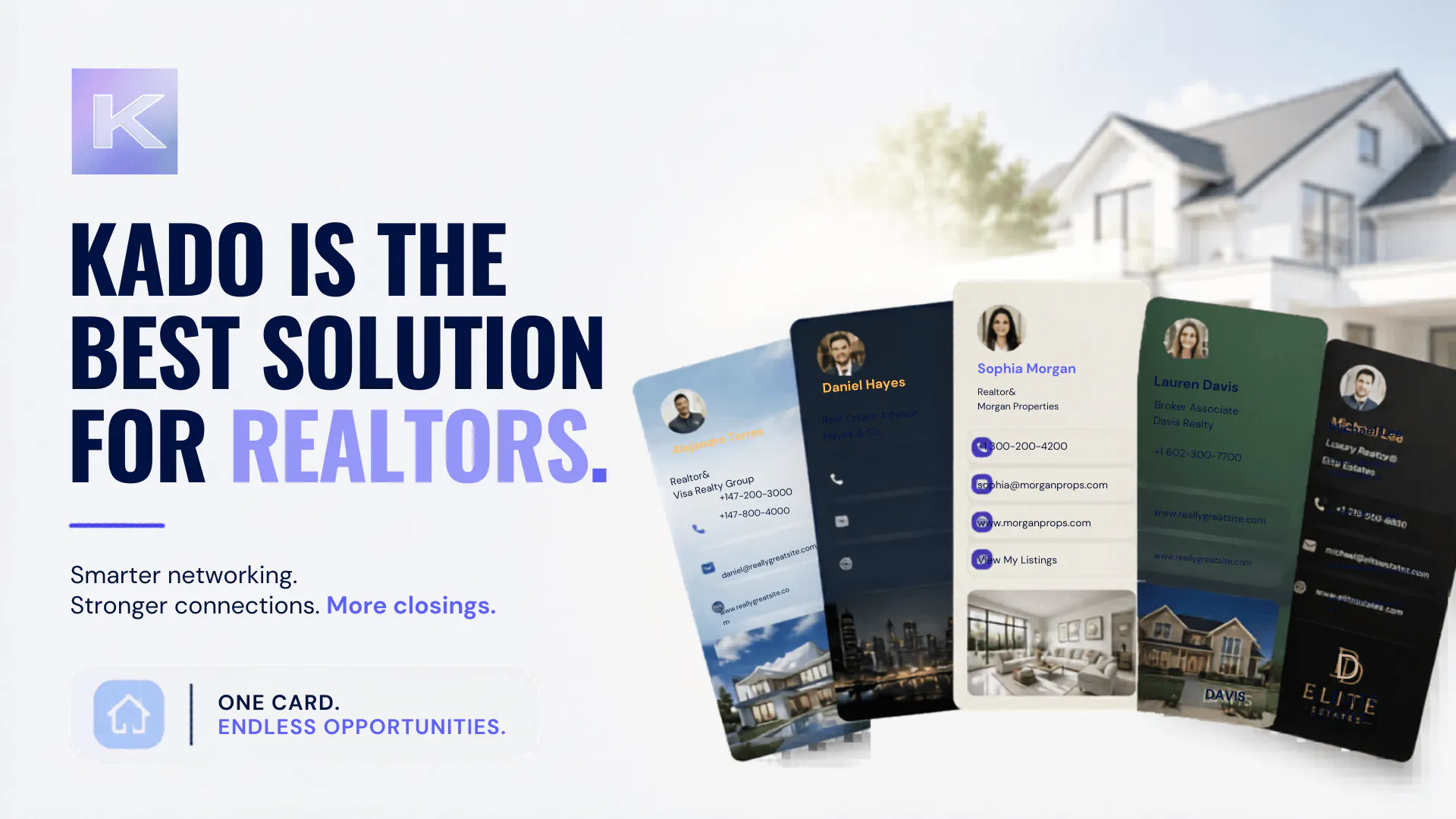
Kadonetworks gives agents a platform to capture leads instantly with digital business cards shared via QR code, NFC, or link, and then sync those contacts directly into your CRM for automated follow-up. The contact management tools mean no lead slips through after an open house or a broker event. For agents who attend trade shows and community events, the event ROI tools measure exactly which in-person efforts are generating real business. Your brand works harder when every handshake becomes a tracked relationship.
Foire aux questions
What is the biggest branding mistake real estate agents make?
Investing in visual design before establishing a discoverable digital presence. A polished logo that nobody finds online delivers no return. Build your search visibility first, then layer in the visual polish that converts browsers into clients.
How often should I update my real estate brand assets?
Audit your brand visuals and messaging once a year, but maintain your digital entity (GBP, reviews, content) actively every week. Fresh photos, new reviews, and regular local content are ongoing signals, not one-time setup tasks.
How do I brand myself as a real estate agent on a small budget?
Claim and fully complete your Google Business Profile at zero cost, register a personal domain, and create branded templates for social media using free design tools. Consistency matters more than expensive design at the start.
What are the most important branding tips for real estate agents?
Start by optimizing your Google Business Profile and ensuring NAP consistency across all directories, then build a personal website on your own domain. Visual identity and consistent messaging across platforms should follow once your digital foundation is solid.