Go back to list of posts
Real Estate Networking Strategies Explained for Realtors
Last modified: June 10, 2026


Building a strong real estate network involves cultivating deep relationships with referral partners in complementary professions such as lenders and inspectors. Effective strategies include consistent follow-up within 48 hours, targeted event attendance, and maintaining an intentional digital presence to generate mutual value.
Real estate networking is the structured practice of building relationships with peers, vendors, and clients to generate referrals and leads that sustain long-term business growth. According to the National Association of Realtors, the majority of buyers and sellers choose their agent based on personal referrals or visible marketing, which means your network is not a supplement to your business. It is the business. Platforms like AgentsGather, LinkedIn, and CRM systems have made it easier than ever to build and maintain those connections at scale. The real question is not whether to network, but how to do it with enough intention that every relationship you build has a clear path to mutual value.
What are the most effective real estate networking strategies for 2026?
The most effective real estate networking strategies combine referral partner development, selective event attendance, and a consistent digital presence. Each of these channels feeds the others when managed well, creating a self-reinforcing pipeline of introductions and opportunities.

Building a referral partner network is the highest-leverage activity most agents underinvest in. Your best referral partners are not other agents. They are mortgage lenders, title representatives, home inspectors, contractors, and estate attorneys. These professionals touch your clients at different stages of the transaction and often know about a move before you do. A lender who pre-approves a buyer is a warm introduction waiting to happen. A contractor finishing a renovation is often the first person a homeowner tells about their plans to sell.
Here are the core strategies that consistently produce results:
- Develop 5 to 10 referral partners across complementary professions. Depth matters more than volume here.
- Attend local and national real estate events with a specific goal per event, whether that is meeting two lenders or connecting with three out-of-market agents.
- Use LinkedIn and AgentsGather for agent-to-agent networking, particularly for building referral relationships across feeder markets.
- Understand the standard referral fee structure. A 25% referral fee is the widely accepted norm between agents for peer-to-peer transactions. This creates a real financial incentive for both sides to send business.
- Choose events selectively. Intentional networking focused on aligned venues reduces burnout and produces stronger connections than attending everything on the calendar.
Pro Tip: Before any networking event, write down one specific type of partner you want to meet. Walking in with a clear target makes your conversations more purposeful and your follow-up more natural.
How to build and maintain a high-value referral network
A high-value referral network is built on trust, not transaction volume. The agents who generate the most referral income are not the ones with the most contacts. They are the ones with the most consistent relationships.
Here is a practical framework for building yours:
- Define your referral niche. Identify your primary market and two or three feeder markets where clients commonly relocate from. A Miami agent, for example, benefits from relationships with agents in New York and Chicago where many buyers originate.
- Create a professional profile that signals referral readiness. Your LinkedIn profile, AgentsGather listing, and website bio should all communicate your specialty, market, and the type of client you serve best. Agents refer to people they trust and understand.
- Systematize your follow-up. Follow up within 48 hours of meeting a new contact, then again at 3 days, 1 week, 2 weeks, and 1 month. This cadence prevents the most common failure in networking: the warm introduction that goes cold because no one followed through.
- Use outbound referrals as a revenue stream. When a client relocates out of your market, refer them to a trusted agent and collect the standard fee. This referral concierge approach strengthens your network and generates income simultaneously.
- Scale with platforms like AgentsGather. Purpose-built platforms for agent-to-agent networking make it faster to identify and vet potential referral partners across markets.
Pro Tip: When following up after an event, send a specific piece of value rather than a generic check-in. Share a market report, a useful article, or a referral. Value-added communication builds relationships; generic messages just create noise.
The table below shows how different referral partner types contribute to your pipeline:
| Partner type | Primary value | Best touchpoint |
|---|---|---|
Mortgage lender | Pre-approved buyer introductions | Weekly or biweekly check-in |
Title representative | Transaction referrals and repeat clients | Monthly lunch or coffee |
Home inspector | Seller leads from pre-listing inspections | Quarterly event or referral exchange |
Contractor or stager | Pre-sale renovation referrals | Project-based introductions |
Estate attorney | Probate and trust sale leads | Quarterly professional meetup |
A strong vendor ecosystem of a few trusted partners in each category creates daily touchpoints with potential clients. This is not about collecting business cards. It is about building a small, reliable circle that sends you business because you send them business.
In-person vs. online networking: how to balance for maximum effectiveness
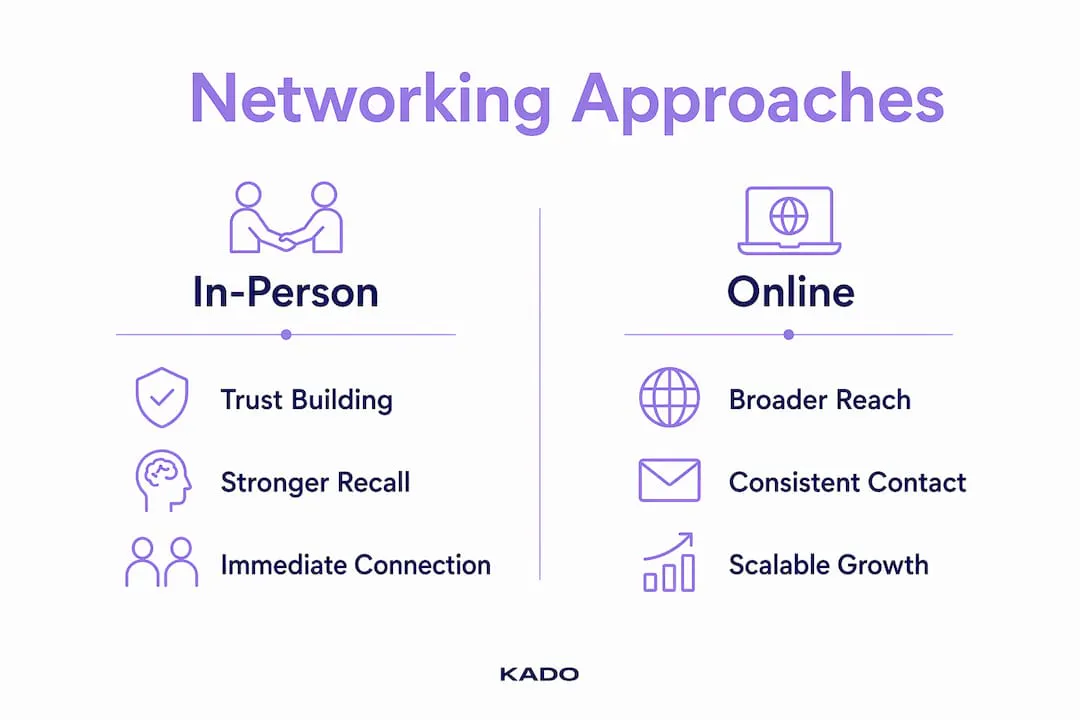
Both channels work. Neither works alone. The agents who grow fastest treat in-person and online networking as two phases of the same relationship, not two separate strategies.
| Channel | Strengths | Limitations |
|---|---|---|
In-person events | Faster trust-building, stronger recall, body language cues | Time-intensive, geographic limits, high cost per contact |
LinkedIn and online platforms | Wider reach, continuous engagement, searchable presence | Slower trust development, easier to ignore, requires consistent content |
Hybrid approach | Combines reach with depth, moves relationships forward faster | Requires discipline to manage both channels consistently |
In-person events accelerate familiarity in ways that digital channels cannot replicate. A 20-minute conversation at a National Association of Realtors conference builds more trust than six months of LinkedIn comments. That said, online platforms extend your reach far beyond what any event schedule can cover.
The most effective approach moves contacts from digital to personal as quickly as possible. Connect with someone on LinkedIn, engage with their content for two weeks, then suggest a 15-minute call. That call is where the relationship actually begins. From there, a coffee meeting or a joint webinar cements it.
For your online presence, consistency matters more than volume. Posting one genuinely useful piece of content per week on LinkedIn, whether a market update, a transaction lesson, or a client story, keeps you visible to your network without requiring a full content operation. Authenticity is the differentiator. Agents who share real experiences and opinions attract the kind of partners who want to work with a real person, not a brand persona.
Common mistakes that derail real estate networking
Most networking failures come down to a small set of repeatable errors. Recognizing them early saves you months of wasted effort.
- Pitching instead of asking. Agents who ask thoughtful questions rather than leading with their pitch create relationships that are far more likely to produce referrals. Your first conversation with a new contact should be mostly about them.
- Attending too many irrelevant events. Networking burnout is real, and it is almost always caused by spreading attention too thin across events that do not align with your business goals. Two well-chosen events per month outperform ten random ones.
- Failing to follow up promptly. The 48-hour follow-up window is not a suggestion. Contacts go cold fast, and a delayed follow-up signals that the meeting was not a priority.
- Chasing immediate leads instead of long-term relationships. Networking is not prospecting. The agent who treats every new contact as a potential transaction will burn through goodwill quickly. The goal is to become someone’s trusted resource, not their next sale.
- Ignoring the vendor ecosystem. Many agents focus exclusively on agent-to-agent referrals and miss the steady lead flow that comes from vetted vendor partnerships. A trusted inspector or lender who mentions your name to three clients a week is worth more than a dozen casual agent connections.
Pro Tip: After every networking event, review your contacts and identify the top two or three worth a personal follow-up. Do not try to follow up with everyone equally. Prioritize depth over breadth from the start.
Key takeaways
Effective real estate networking requires depth over volume, a structured follow-up cadence, and a deliberate mix of in-person and digital channels to build referral relationships that generate consistent business.
| Point | Details |
|---|---|
Referral partners over volume | Build 5 to 10 deep relationships with lenders, inspectors, and title reps rather than collecting hundreds of contacts. |
Follow up within 48 hours | Contact new connections within two days, then at 3 days, 1 week, 2 weeks, and 1 month to maintain momentum. |
Standard referral fee is 25% | Use the accepted 25% fee structure to formalize peer-to-peer referral agreements and create mutual incentive. |
Balance in-person and digital | Use online platforms to build reach, then move relationships to calls and meetings where trust deepens faster. |
Avoid networking burnout | Choose events that align with your business goals and skip those that do not, regardless of how well-attended they are. |
What we have learned about networking that most agents overlook
The conventional advice on real estate networking tells you to show up everywhere, hand out cards, and follow up fast. That advice is not wrong, but it is incomplete. What we have found, after working with thousands of real estate professionals through Kadonetworks, is that the agents who build the most durable businesses are not the most visible ones. They are the most connected ones within a small, trusted circle.
Top producers build narrow and deep networks with 5 to 10 core partners who send them business consistently. They are not trying to know everyone. They are trying to be indispensable to a few people who already know and trust them. That distinction changes how you spend your time entirely.
The other thing most agents underestimate is the power of becoming a connector. When you introduce your lender to your contractor, or your title rep to a new agent in your office, you create social capital that comes back to you in ways that are hard to trace but impossible to ignore. People remember who made the introduction. They remember who thought of them.
Disciplined follow-up with genuine value is what separates the agents who build real networks from those who just attend events. A market update sent to ten specific people beats a mass email sent to five hundred. The goal is to make every contact feel like you thought of them specifically, because you did.
— KADO
How Kadonetworks helps you turn connections into clients

Real estate networking only produces results when your contacts are organized and your follow-up actually happens. Kadonetworks gives agents the tools to capture and manage contacts from every event, meeting, and digital interaction in one place. Share your digital business card via QR code or NFC at your next open house or conference, and every contact lands directly in your pipeline with no manual data entry. From there, you can track relationship history, schedule follow-ups, and sync with your CRM so nothing falls through the cracks.
For agents who attend multiple events each year, Kadonetworks also helps you measure event ROI by tracking which contacts and referrals originated from specific events. That data tells you exactly where to invest your networking time next year. If you are serious about building a referral pipeline that works without constant manual effort, Kadonetworks is built for exactly that.
Frequently Asked Questions
Should I focus more on in-person or online networking?
Use both, but treat them as phases of the same relationship. Online platforms like LinkedIn build initial visibility and reach, while in-person meetings and calls are where trust actually forms. Move digital contacts to personal conversations as quickly as possible.
How do I avoid networking burnout as a Realtor?
Focus on a small number of events that directly align with your business goals and skip those that do not. Intentional, selective networking produces stronger relationships and conserves the energy you need to follow up effectively.
What is real estate networking and why does it matter?
Real estate networking is the practice of building relationships with peers, vendors, and clients to generate referrals and leads. The National Association of Realtors confirms that most buyers and sellers choose their agent through personal referrals, making networking one of the highest-return activities an agent can invest in.