Go back to list of posts
Professional Networking Guide: Build Connections and Boost Leads
Last modified: August 12, 2026


Effective networking requires intentionality through assessing your current contacts, diversifying relationships, and maintaining consistent follow-up. Building and managing a digital contact system enhances your ability to nurture genuine, long-term professional relationships. Strategic, mutually beneficial engagement far outweighs random connections or superficial contact collection.
Chasing random connections at every event or sending cold messages to strangers rarely produces sustainable business growth. Most professionals collect contacts like business cards in a drawer and wonder why nothing comes of it. The real difference between a stagnant contact list and a thriving network is intentionality. Harvard Business School recommends assessing your current network, auditing your online presence, building diverse relationships, offering shared value, and committing to consistent follow-up. This guide gives you a practical, step-by-step blueprint to build, maintain, and leverage your professional network for real, ongoing business results.
Key Takeaways
| Point | Details |
|---|---|
Start with a plan | Assess your network and set specific, purposeful goals before networking. |
Pick the right tools | Centralize contacts with digital management tools and smart business cards for efficiency. |
Nurture consistently | Regular, value-based follow-up strengthens relationships and boosts sales. |
Avoid common mistakes | Skip transactional networking and focus on long-term value and diversity in your connections. |
Leverage technology | Digital solutions amplify impact, making follow-up and tracking easier for busy professionals. |
Laying the groundwork for effective networking
Before you send a single connection request or attend your next industry event, you need a clear picture of where you stand. Self-assessment is not optional. It is the step that separates professionals who network with purpose from those who just collect contacts.
Start with an honest audit of your current network. Ask yourself: Who do I actually talk to? Are my contacts concentrated in one industry, one role, or one geography? Do I have relationships with people who challenge my thinking, or am I surrounded by people who already agree with me? This kind of reflection surfaces gaps you can act on. It also prevents you from doubling down on a network that is already too narrow.
Polish your digital presence before you reach out. Your LinkedIn profile, personal website, and social platforms are the first things people check after meeting you. If your LinkedIn summary is vague, your profile photo is outdated, or your website has broken links, you are losing credibility before the conversation even starts. Review every platform you use professionally and ask: does this clearly communicate who I am, what I do, and what value I offer?
Setting specific, measurable networking goals keeps you focused. Instead of “I want to meet more people,” try “I want to connect with five marketing directors in SaaS companies this quarter and have one meaningful conversation with each.” Quality beats quantity every time. You can explore pro tips to grow your professional network for goal-setting frameworks that actually hold up in practice.
Key preparation steps at a glance:
- ✅ Audit your existing contacts for diversity of industry, role, and geography
- ✅ Update all public profiles with current information and a clear value proposition
- ✅ Define 2 to 3 specific networking goals with measurable outcomes
- ✅ Identify gaps in your network (e.g., no connections in adjacent industries)
- ✅ Research relationship networking strategies to find approaches that match your goals
“The most effective networkers don’t just grow their networks. They grow the right networks, with intention and mutual benefit at the center of every interaction.” — Harvard Business School, intentional networking tips
Network diversity matters more than most people realize. If everyone in your network works in the same industry or holds the same type of role, you end up with an echo chamber. Diverse connections expose you to different perspectives, opportunities, and referral sources you would never encounter otherwise.
| Network health factor | Low-quality signal | High-quality signal |
|---|---|---|
Industry diversity | Single industry | Multiple industries |
Role diversity | Same seniority level | Mix of roles and levels |
Follow-up frequency | Rarely or never | Consistent, scheduled |
Value exchange | One-sided asks | Mutual benefit |
Digital presence | Outdated or incomplete | Current and compelling |
Pro Tip: Before reaching out to anyone, ask yourself: “What can I offer this person?” If the answer is nothing, do more research or find a different angle. Mutual value is the litmus test for every outreach.
Choosing and using digital tools for contact management
Once your foundation is solid, the next challenge is scale. Managing a growing network manually, through sticky notes, scattered spreadsheets, or a disorganized inbox, leads to missed follow-ups and lost relationships. The right digital tools make networking sustainable and repeatable.
Core features to look for in any networking tool:
- ✅ Contact enrichment (automatically pulling in job titles, company info, and social profiles)
- ✅ Interaction logging (notes on every conversation, meeting, or email)
- ✅ Reminder and follow-up scheduling
- ✅ Integration with email, calendar, and CRM platforms
- ✅ Mobile access for capturing contacts on the go
Digital business cards are one of the most underrated tools in this stack. Unlike paper cards that get lost in a jacket pocket, a digital card can be updated instantly, shared via QR code or NFC tap, and linked directly to your contact management system. When someone scans your card, their information flows directly into your pipeline. No manual data entry. No lost leads. Explore digital contact management tools to see how this works in practice.
Choosing the right system depends on your situation. Solo professionals often do well with a dedicated networking app or a lightweight CRM. Small teams benefit from platforms that offer shared contact databases and role-based access. Enterprise organizations need full CRM integrations, automated workflows, and security features like encrypted storage. A solid client relationship management overview can help you understand which tier fits your needs.
Here is a practical comparison of common tool categories:
| Tool type | Best for | Key limitation |
|---|---|---|
Spreadsheet (Excel, Sheets) | Solo professionals, tight budgets | No automation, easy to lose data |
Networking apps (e.g., Contacts+) | Individuals managing 100 to 500 contacts | Limited CRM features |
Mid-tier CRM (e.g., HubSpot free) | Small teams, growing pipelines | Steeper learning curve |
Full-scale CRM (e.g., Salesforce) | Enterprise sales teams | Cost and complexity |
Digital business card platforms | All sizes, event-heavy networkers | Requires adoption from contacts |
One stat worth knowing: LinkedIn native lead gen forms convert at 13% compared to just 4% for standard landing pages, and consistent lead nurturing can increase sales by up to 50%. That tells you something important. The tools you use to capture and nurture contacts are not just administrative conveniences. They directly affect your revenue.
Pro Tip: Centralize all your contacts in one system from day one. Fragmented contact lists across multiple apps, email threads, and spreadsheets are a silent killer of networking ROI. Pick one platform and commit to it.
Step-by-step: Building, nurturing, and leveraging your network
With the right tools in place, you need a repeatable process. Here is a sequential workflow that takes you from first contact to productive, long-term professional relationship.

1. Identify your target connections with purpose. Use LinkedIn, industry events, alumni networks, and professional associations to find people who align with your specific networking goals. Do not reach out blindly. Research each person before you contact them.
2. Initiate contact with a value-first message. Skip the generic “I’d love to connect” opener. Instead, reference something specific: a post they wrote, a challenge their industry faces, or a mutual connection. Example: “I read your piece on supply chain resilience last month and found your point about nearshoring really useful. I work in procurement and would love to exchange perspectives.”
3. Share your digital business card at the right moment. After an initial exchange, share your digital card via QR code or a direct link. This gives the other person everything they need to follow up, and it captures their contact info in your system automatically.
4. Log the interaction immediately. Add a note about what you discussed, what they care about, and what a useful next step might look like. This context is gold when you follow up weeks later.
5. Follow up within 48 hours. A short, specific message referencing your conversation shows you were paying attention. You can use follow-up email templates to keep this step fast without making it feel templated.
6. Nurture the relationship on a schedule. Set a reminder to check in every 4 to 8 weeks. Share a relevant article, congratulate them on a milestone, or make an introduction that benefits them. Consistent follow-up is one of the most cited factors in long-term networking success, and it is the step most professionals skip.
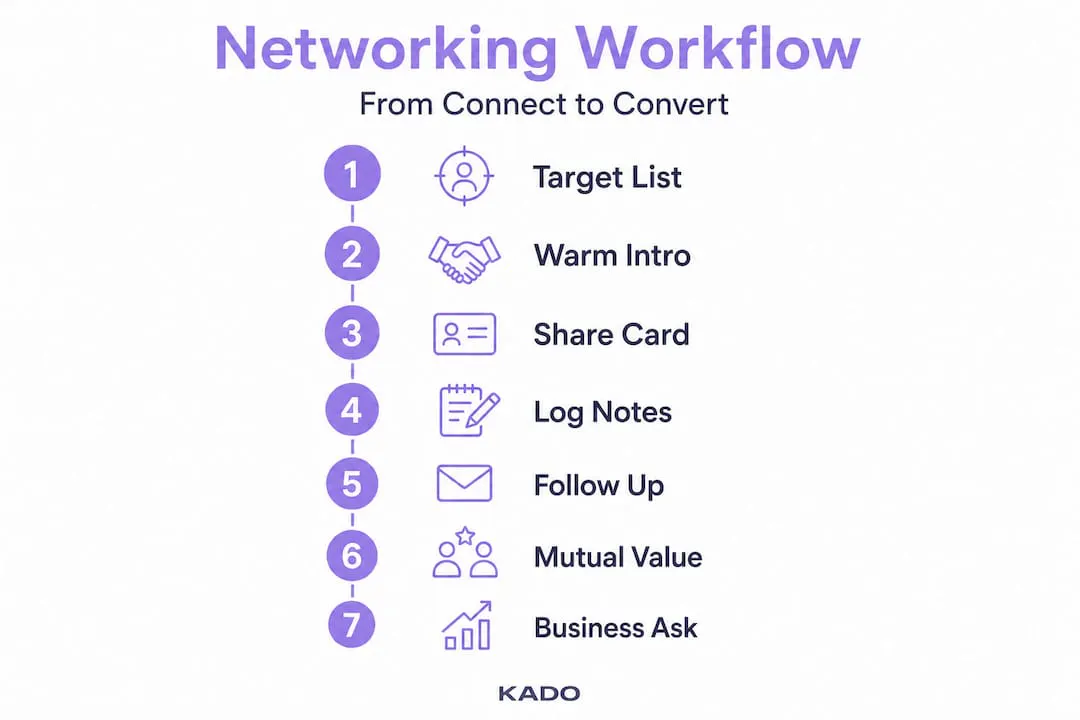
7. Create mutual value over time. The goal is not to collect a favor. It is to build a relationship where both parties genuinely benefit. Introduce your contacts to each other when it makes sense. Recommend their work. Offer your expertise without expecting anything in return.
8. Convert relationships into business outcomes. When the time is right, a warm ask to a well-nurtured contact is far more effective than any cold outreach. Nurtured leads generate 50% more sales than contacts who never received consistent engagement. The math is clear.
For virtual and hybrid environments, the same principles apply. Virtual networking advice can help you adapt these steps for online events and remote relationship-building. You can also study a structured lead generation workflow to see how the best sales teams systematize this process at scale.
Pro Tip: Build a simple follow-up schedule in your CRM or calendar. Assign each contact a follow-up frequency (monthly, quarterly, or annually) based on relationship strength. This turns a chaotic task into a manageable system.
Common networking mistakes and how to fix them
Even professionals with a solid plan make avoidable mistakes. Recognizing these patterns early saves you time and protects your reputation.
The most common networking pitfalls:
- ⚠️ Being too transactional. Reaching out only when you need something signals that you see people as resources, not relationships. Fix this by giving before you ask, every single time.
- ⚠️ Neglecting follow-up. Meeting someone at an event and never following up is the networking equivalent of leaving money on the table. A single, specific follow-up message can keep a promising connection alive.
- ⚠️ Failing to diversify. Sticking to the same industry or role type limits your exposure to new ideas and opportunities. Intentionally seek connections outside your usual circles.
- ⚠️ Not tracking interactions. Without a digital system, you forget who you talked to, what you discussed, and when to follow up. This is where networking mistakes to avoid become costly.
- ⚠️ Mistaking quantity for quality. A network of 5,000 weak connections is less valuable than 200 strong, mutually beneficial relationships.
“Avoid transactional networking. Focus on mutual value and long-term relationships as the foundation of every connection you build.” — Harvard Business School, intentional networking tips
One pattern we see repeatedly: professionals invest heavily in attending events and collecting contacts, then do nothing with them afterward. The event itself is not the networking. The follow-up is. Talent networking best practices from HR leaders reinforce this point: the relationships that produce real outcomes are built between events, not at them.
Why lasting networks outshine fleeting connections
Here is an uncomfortable truth most networking guides skip: lead generation metrics are seductive, but they can actually distort your networking strategy if you let them run the show.
We have seen professionals optimize their networking around LinkedIn connection counts, event attendance numbers, and email open rates, and end up with a pipeline full of lukewarm contacts who barely remember them. The metrics looked great. The results were not.
What actually compounds over time is not the size of your network. It is the depth of a smaller number of genuine relationships. A contact who trusts you will refer business without being asked. They will vouch for you in rooms you are not in. They will share opportunities before those opportunities are public. That is the return on investment that does not show up in a spreadsheet until years later.
Digital tools amplify this, but they do not replace it. A well-configured CRM or digital business card platform helps you stay organized and consistent. It removes the friction from follow-up. But the human judgment, knowing when to reach out, what to say, and how to add value, still comes from you.
We believe the professionals who build the most durable networks treat every contact as a long-term investment, not a short-term transaction. Small, intentional actions, a relevant article shared at the right moment, a timely introduction, a genuine congratulation, compound into something that no cold outreach campaign can replicate. Explore deeper networking insights to see how this plays out across different career stages and industries.
The contrarian view worth holding: relationships are your real asset in any business cycle. Leads dry up. Markets shift. But a strong network adapts with you.
Take your networking to the next level with KADO
You now have a clear framework: assess your network, set goals, choose the right tools, follow a repeatable process, and avoid the most common pitfalls. The next step is putting it all into motion with tools built specifically for this kind of strategic networking.
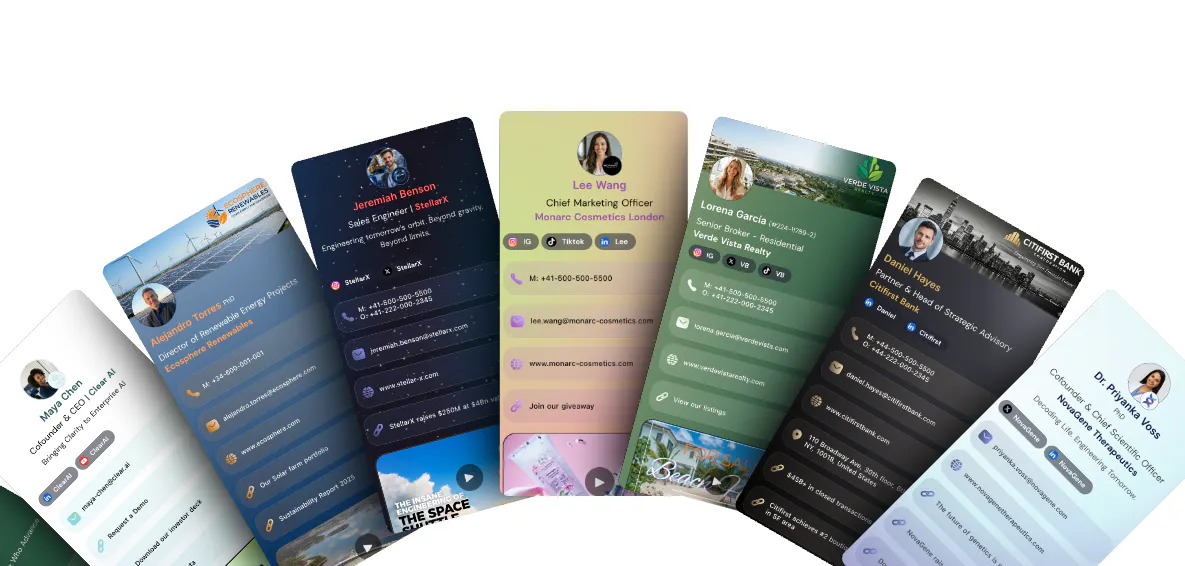
KADO’s contact management platform centralizes your contacts, automates follow-up reminders, and integrates with the CRM tools your team already uses. Our NFC business cards make sharing and capturing contact information effortless at any event, turning a tap or scan into a tracked lead. For teams focused on events, our event ROI solution helps you measure the real business impact of every networking activity. Whether you are a solo professional or managing a sales team, KADO is designed to help you network smarter, not harder.
Frequently Asked Questions
What is the most effective way to grow a professional network?
Start with a clear goal, diversify your connections across industries and roles, and commit to consistent, mutually valuable follow-up using digital tools. Harvard Business School’s research confirms that these habits, combined, produce the strongest long-term results.
How do digital business cards improve networking?
Digital business cards make sharing, updating, and organizing contact information seamless across multiple platforms, eliminating the friction of manual data entry and lost paper cards.
Why is nurturing relationships important in business networking?
Consistent relationship nurturing can increase sales by up to 50% compared to one-off engagements, making it one of the highest-return activities in any networking strategy.
What’s a common networking mistake to avoid?
Purely transactional outreach is the most damaging pattern. Focusing on mutual value and long-term relationship-building consistently outperforms short-term, ask-first approaches.
How can I measure the ROI of networking activities?
Track both relationship depth (engagement frequency, referrals generated, introductions made) and leads produced over time using a digital contact management system that logs every interaction.