Go back to list of posts
Elevate networking and lead management with digital identity
Last modified: June 16, 2026


Digital identity is evolving from a security measure to a strategic asset for growth and trust. Verified, deterministic identities enhance lead quality, streamline onboarding, and enable faster, more accurate networking. Emerging risks include AI fraud and agent identity challenges, requiring advanced verification technologies and compliance practices.
Digital identity is no longer just a security checkpoint. For sales, marketing, and enterprise professionals, it’s quietly becoming one of the most powerful levers for growth, trust, and pipeline quality. Most teams still treat it as an IT concern, something to satisfy compliance or prevent fraud. But digital identity is evolving from a defensive tool into a strategic asset that can directly improve lead quality, accelerate onboarding, and build the kind of verified professional networks that actually convert. This guide breaks down exactly how to harness that potential.
Key Takeaways
| Point | Details |
|---|---|
Verified connections boost trust | Using digital identity tools helps professionals build trusted, high-value networks while reducing fraud risks. |
Lead management gets smarter | Digital identity enables accurate lead verification, streamlining onboarding and boosting CRM performance. |
AI and standards drive the future | Adopting AI-driven, standards-based identity frameworks positions organizations for regulatory compliance and scalable growth. |
Future-proof your networking | Integrating digital identity wallets and adaptive security gives businesses a powerful edge in evolving sales and marketing landscapes. |
What is digital identity in the modern business landscape?
Digital identity refers to the digital representation of a real-world person or organization, built from verifiable attributes like credentials, contact details, behavioral signals, and authentication records. It’s not just a username and password. It’s a layered, dynamic profile that travels with you across platforms and interactions.
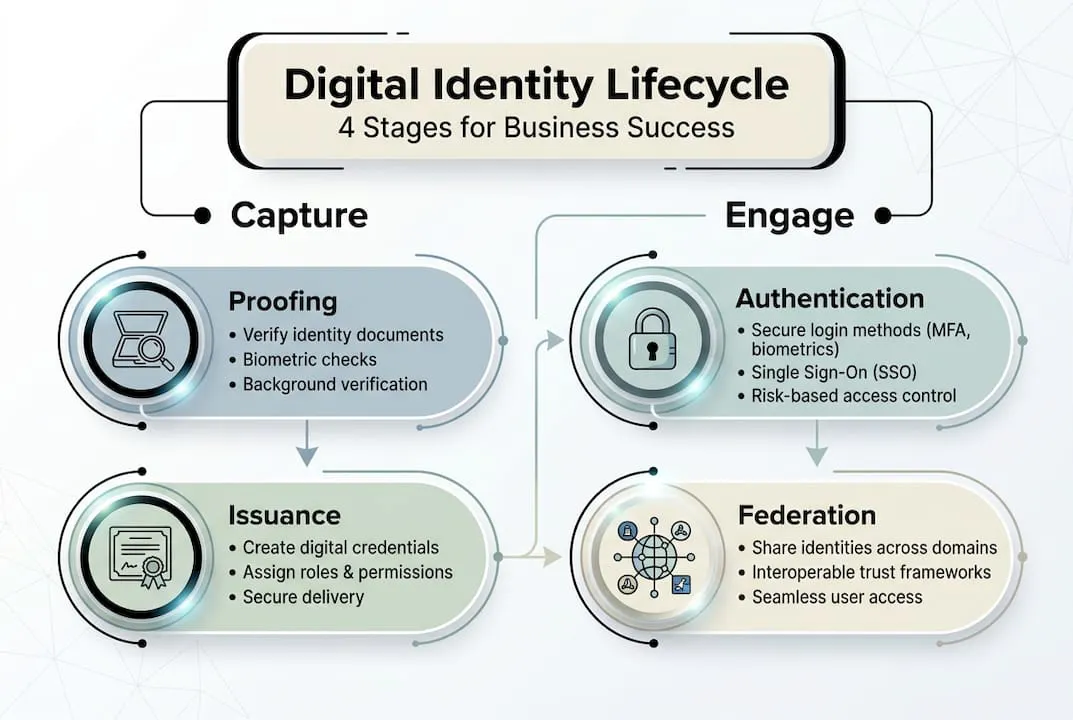
The core mechanics follow a clear lifecycle: identity proofing (confirming who someone really is), credential issuance (assigning verified claims), authentication (validating identity at each touchpoint), and lifecycle management (keeping that identity current and secure). Digital identity serves as a foundational element for secure networking and lead management by enabling verified, persistent identities across platforms.
Two major standards shape how organizations implement this today:
| Standard | Scope | Key strength |
|---|---|---|
NIST SP 800-63 | U.S. federal and enterprise | Rigorous identity assurance levels |
eIDAS 2.0 | European Union | Cross-border interoperability and digital wallets |
GDPR | EU data handling | Consent and data minimization |
In enterprise networking, verified identity provides trusted context. You know who you’re talking to, what role they hold, and whether their credentials are current. That context reduces fraud and raises the quality of every interaction in your pipeline. Explore more on digital business card insights to see how identity ties into modern professional networking.
Pro Tip: Before adopting any identity platform, confirm your CRM can accommodate emerging credential formats like W3C Verifiable Credentials. Retrofitting later costs far more than planning ahead.
How digital identity transforms networking and lead management
Traditional lead management relies on probabilistic data enrichment: matching names, emails, and job titles across databases and hoping the data is accurate. Digital identity flips that model. It introduces deterministic proof, where a lead’s identity is cryptographically verified, not guessed.
Digital identity wallets enable deterministic lead verification and portable consent for CRM and email integration. That means a prospect can share verified contact data directly into your system, with their explicit permission, and you can trust it’s accurate from the start.
“62% of B2B marketers cite contact data accuracy as their biggest challenge.”
That stat alone should reframe how you think about identity. Bad data doesn’t just waste time. It erodes campaign performance, skews pipeline forecasts, and frustrates sales reps chasing dead ends.
Here’s how the shift looks in practice:
| Process | Old approach | With digital identity |
|---|---|---|
Lead capture | Form fills, manual enrichment | Verified credential exchange |
Onboarding | Multi-step verification delays | Frictionless, pre-verified entry |
CRM data quality | Periodic cleansing campaigns | Real-time, consent-based accuracy |
Compliance | Retroactive consent management | Built-in, portable consent |
The direct benefits for professionals who manage business contacts with verified identity include:
- ✅ Higher network quality through verified professional connections
- ✅ Faster trust-building with prospects and partners
- ✅ Reduced friction in onboarding and lead qualification
- ✅ Stronger data compliance aligned with security and compliance practices
- ✅ Better segmentation because your data actually reflects reality
The result is a pipeline that’s cleaner, faster, and built on genuine relationships rather than guesswork.
Frameworks, standards, and real-world applications
Knowing the value of digital identity is one thing. Implementing it without disrupting your existing workflows is another. The good news: established frameworks make this manageable.
Standardized workflows include identity proofing, credential issuance, authentication, and federation, following frameworks like NIST SP 800-63 for interoperability. The full NIST SP 800-63-4 guidelines are worth reviewing for any enterprise implementation.
Here’s a practical framework comparison:
| Framework | Best for | Limitation |
|---|---|---|
NIST SP 800-63 | Enterprise, U.S. regulated industries | Complex to implement at scale |
eIDAS 2.0 | EU cross-border operations | Requires wallet infrastructure |
GDPR consent model | Data-sensitive marketing | Adds consent workflow overhead |
For a sales-focused organization, the implementation path typically looks like this:
- Audit your current identity touchpoints across CRM, SEP (sales engagement platform), and onboarding flows.
- Select an identity assurance level based on your risk profile using NIST guidelines.
- Integrate verifiable credential support into your CRM and lead capture forms.
- Train your sales and marketing teams on how verified identity changes qualification criteria.
- Monitor and iterate using identity-linked engagement metrics.
Sales enablement platforms are integrating digital identity features to boost collaboration and customer insights. For industries with high trust requirements, like financial advisory solutions or consulting engagements, this integration is no longer optional. It’s a competitive baseline.
Pro Tip: Don’t let perfect be the enemy of good. Start with identity verification at your highest-value lead entry points, then expand. Adaptive risk controls let you apply stronger verification only when signals suggest elevated risk.
Emerging risks and future trends in digital identity
The same technology advancing digital identity is also arming bad actors. AI-generated deepfakes can now convincingly spoof video verification. Automated agents operate across your systems without human oversight. And compliance requirements keep tightening.
Deepfakes and AI fraud are actively countered by liveness detection and behavioral biometrics, two technologies that analyze micro-movements and interaction patterns to confirm a real human is present. These aren’t futuristic tools. They’re available now and increasingly necessary.
“74% of consumers prioritize trustworthiness, while 64% fear identity fraud.”
That gap between expectation and anxiety is your opportunity. Brands that visibly invest in verified identity earn faster trust from prospects who are already skeptical.
The emerging risk of agent identity management is also growing. As AI agents handle more outreach, scheduling, and CRM updates on behalf of humans, organizations need identity frameworks that cover non-human actors too.
Here are immediate steps to future-proof your identity management, especially for enterprise IAM security:
- ⭐️ Deploy liveness detection at high-risk verification points
- ⭐️ Implement behavioral biometrics to flag anomalous login patterns
- ⭐️ Establish identity policies for AI agents operating in your systems
- ⭐️ Audit consent records quarterly to stay ahead of regulatory shifts
- ⭐️ Evaluate hybrid identity models that blend centralized control with decentralized portability
Hybrid models, combining centralized identity governance with decentralized wallet-based credentials, are gaining traction in enterprise environments. They offer the control IT teams need alongside the user experience professionals expect.
The revenue edge: Digital identity as a business growth engine
Most organizations frame digital identity around defense: prevent fraud, satisfy auditors, avoid fines. That framing leaves significant revenue on the table.

Placing digital identity at the center of data-driven models can shift enterprise focus from fraud defense to revenue growth. The logic is straightforward. Verified identity improves lead quality. Better leads close faster. Faster closes improve revenue velocity. And trusted networks generate referrals that probabilistic data never could.
Integrating AI with verifiable credentials can produce 50 to 70% gains in lead qualification accuracy, because your models are trained on verified data rather than enriched guesses. That’s not a marginal improvement. It’s a structural advantage.
Here’s how to activate digital identity as a growth engine across industries and verticals:
- ✅ Replace anonymous form fills with verified credential exchanges at key conversion points
- ✅ Use identity-linked data to personalize outreach with precision, not assumptions
- ✅ Build partner ecosystems where verified identity enables faster trust and faster deals
- ✅ Tie loyalty and retention programs to verified identity for more accurate attribution
- ✅ Create identity-gated content or events that attract higher-quality prospects by design
Pro Tip: Start preparing your CRM and marketing stack for wallet-based lead verification now. By 2026, wallet-native credential sharing is expected to become standard in regulated industries. Early adopters will have a measurable head start.
Why most professionals miss the true impact of digital identity
Here’s what we’ve observed across sales and marketing teams: most organizations treat digital identity as a compliance checkbox. They verify identities at onboarding, satisfy their security team, and move on. The strategic opportunity never gets discussed in a revenue meeting.
That’s a costly blind spot. You wouldn’t invite a mystery guest to your most important client meeting. So why accept random, unverifiable contacts into your CRM and treat them the same as qualified, verified leads?
The professionals who gain the most from digital identity are those who embrace verification early and build it into their networking workflows from the start. They capture better leads, build faster trust, and create networks that compound in value over time. If you’re ready to see what that looks like in practice, try digital business card tech that puts verified identity at the center of every connection.
Bridge digital identity to next-gen networking tools
Ready to move from theory to action? KADO makes it practical.
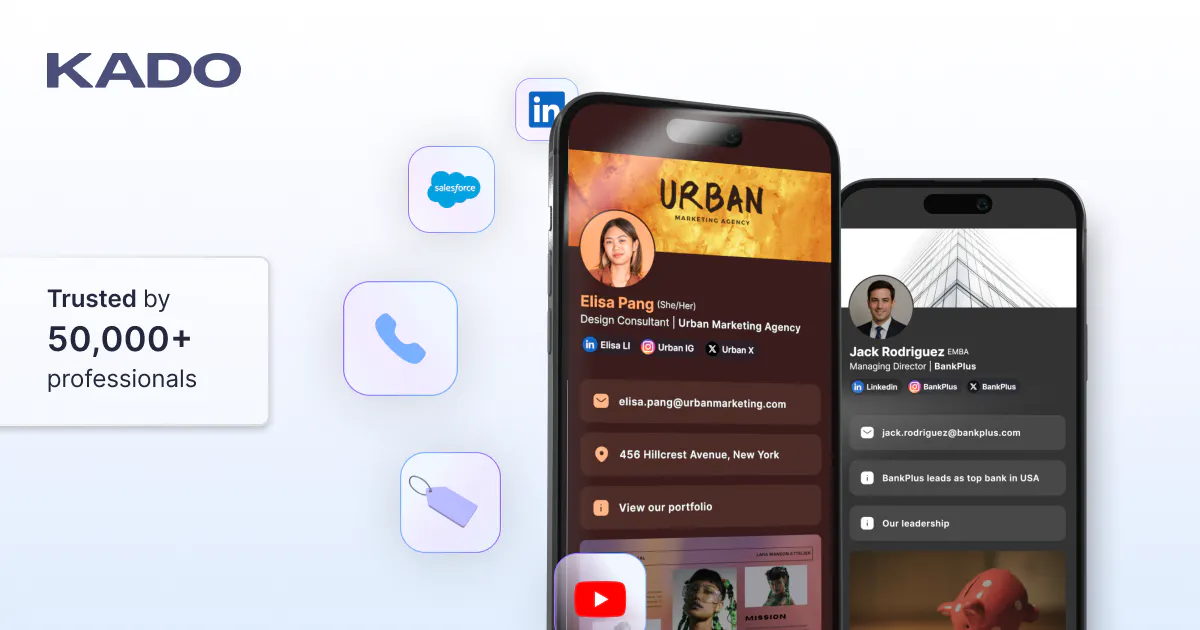
KADO’s platform is built for professionals who need more than a contact exchange. It’s designed for verified, trust-first networking that feeds directly into your lead management workflows. Whether you’re in financial advisory or managing a distributed sales team, KADO connects digital identity principles to real, shareable tools. Explore virtual contact management features that sync with your CRM, or request a demo to see how KADO can elevate the quality of every professional connection you make.
Frequently Asked Questions
What is a digital identity in business?
A digital identity in business is a digital representation of a person or entity using verifiable attributes that enable secure, consistent identification across platforms. Digital identity serves as a foundational element for secure networking and lead management.
How does digital identity improve lead management?
It enables deterministic verification of lead information, improves data accuracy, and streamlines onboarding in CRM and email workflows. Digital identity wallets enable deterministic lead verification for CRM and consent management.
What are the main risks associated with digital identity today?
Major risks include AI-generated identity fraud like deepfakes, agent identity management gaps, and evolving compliance requirements around consent and privacy. Deepfakes and AI fraud are countered by liveness detection and behavioral biometrics.
What standards should businesses follow for digital identity?
Businesses should focus on NIST SP 800-63, eIDAS 2.0, and GDPR consent requirements to ensure secure, interoperable digital identity systems. These standardized workflows cover identity proofing, credential issuance, authentication, and lifecycle management.