Retour à la liste des articles
Why sustainability in business networking matters for ROI
Dernière modification: April 27, 2026


Virtual and hybrid events significantly reduce carbon footprints and deliver higher ROI. Embedding sustainability in networking enhances brand reputation, attracts talent, and strengthens partnerships. Digital tools enable measurable ESG impact, lower costs, and expand global connection opportunities.
Most decision-makers still assume that meaningful business connections require handshakes, hotel ballrooms, and frequent flier miles. That assumption is becoming expensive in more ways than one. Virtual and hybrid events drastically reduce carbon footprints by eliminating travel, minimizing waste, and lowering energy use for venues. More importantly, they also deliver sharper ROI. Sustainability is no longer a compliance checkbox or a PR move. For sales teams, marketers, and enterprise decision-makers, it is quietly becoming the most powerful lever in building networks that grow revenue, attract talent, and earn long-term trust.
Key Takeaways
| Point | Details |
|---|---|
Sustainable networking multiplies business value | Prioritizing sustainability in your network directly boosts trust, reputation, and financial performance. |
Digital tools cut costs and emissions | Virtual and hybrid networking options reduce travel, waste, and expenses compared to traditional methods. |
Proof of ROI through benchmarks | Real-world case studies and metrics prove that sustainable business networking delivers higher deal velocity and lasting relationships. |
Hybrid strategies deliver the best results | Combining digital with selective in-person events maximizes both impact and engagement while keeping sustainability top of mind. |
What makes sustainability crucial in business networking?
Sustainability in business networking has moved well beyond recycled name badges and carbon offset credits. It now shapes how partners choose each other, how talent evaluates employers, and how regulators assess corporate responsibility. If your networking strategy still ignores sustainability, you are likely losing ground without realizing it.
Here is what is driving the shift:
- ✅ ESG compliance pressure: Investors and regulators are tightening environmental, social, and governance (ESG) reporting requirements. Your network partners will increasingly scrutinize your sustainability credentials before signing deals.
- ✅ Talent attraction: Professionals, especially in sales and marketing, gravitate toward organizations with clear sustainability commitments. Your network signals your values.
- ✅ Competitive differentiation: Sustainable practices are becoming a market signal. Companies that lead on this front are viewed as forward-thinking partners.
- ✅ Knowledge transfer at scale: Business networks facilitate adoption of sustainable practices through knowledge transfer, collaboration, and key connector roles across industries.
“Networks don’t just connect people. They accelerate behavioral change across entire industries when the right connectors are in place.”
The data behind this shift is striking. Sustainability is now a core business function for 96% of leading firms, up from just 45% in 2002. That is not a trend. That is a structural change in how business is done.
For professionals operating across digital networking in every industry, the implication is clear. Embedding sustainability into your networking approach is not idealism. It is competitive strategy. The organizations that treat their networks as vehicles for sustainable adoption are building trust compounding assets that perform better over time than any single deal or campaign.
Sustainability also protects your network from reputational risk. One high-profile partner with poor environmental practices can taint your brand by association. Curating a network aligned with shared sustainability values is both a defensive and offensive move.

How digital networking advances sustainability goals
Understanding the ‘why’ sets the stage. Now let’s see how modern digital networking tools turn intention into measurable impact.
The numbers on emissions are hard to ignore. Virtual and hybrid events cut 70 to 80% of emissions compared to traditional in-person events, while also reducing costs and supporting ESG and CSR tracking. For enterprise sales and marketing teams running dozens of events annually, that reduction compounds fast.
| Networking format | Estimated emissions reduction | Cost savings | Waste reduction |
|---|---|---|---|
Fully virtual | Up to 80% | High | Near total |
Hybrid model | 50 to 70% | Moderate | Significant |
Traditional in-person | Baseline | Baseline | Baseline |
Beyond emissions, digital networking tools support ESG and CSR goals, enhance brand reputation, cut operational costs, enable global reach, and provide measurable ROI tracking. That last point matters enormously for decision-makers who need to justify budgets.
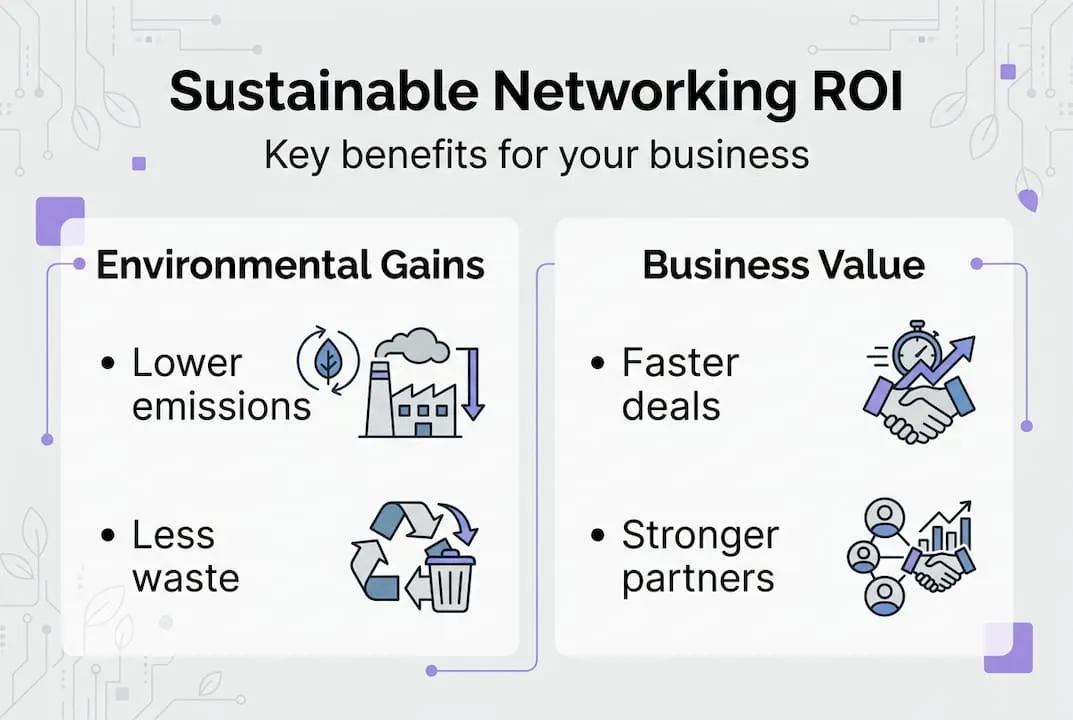
Digital tools also remove geographic barriers. A sales professional in Austin can build a meaningful relationship with a partner in Singapore without a 20-hour flight. That is not just good for the environment. It opens markets that were previously cost-prohibitive to access.
Hybrid models, in particular, offer the best balance. Pure virtual setups maximize emissions savings but can feel impersonal for high-stakes relationships. Hybrid formats preserve some in-person depth while capturing most of the sustainability gains. For teams exploring digital networking for energy industry applications, hybrid is often the most practical starting point.
Pro Tip: Use the built-in analytics dashboards in your digital networking platforms to track footprint reductions over time. Many platforms now let you quantify paper saved, travel avoided, and venue energy eliminated. That data feeds directly into your ESG reports and gives your leadership team a clear picture of progress. You can see a digital card demo to understand how contact exchange tracking works in practice.
Real-world case studies: ROI and business impact
The benefits sound promising. So what do results look like in practice? Let’s examine evidence from real organizations.
HP’s Amplify Impact program is one of the most instructive examples available. The HP Amplify Impact program engaged 4,800 partners across 48 countries, exceeded its sustainability targets, and drove billions in sustainability-influenced sales without using direct financial incentives. The lever was the network itself. Partners motivated each other through shared goals and peer accountability.
That case illustrates something counterintuitive. Sustainable networking does not require big incentive budgets. It requires the right structure and shared values.
On the ROI side, the data is equally compelling. Deals with networked partners are 53% more likely to close, 46% faster, and average relationships can drive $12,000 in lifetime value. When you combine those figures with cost savings from digital formats, the business case becomes undeniable.
| Metric | Traditional networking | Digital/sustainable networking |
|---|---|---|
Deal close rate | Baseline | 53% higher |
Sales cycle length | Baseline | 46% faster |
Relationship lifetime value | Variable | Up to $12K average |
Event cost per attendee | High | Significantly lower |
Here are the top three metrics worth tracking when evaluating your networking ROI:
- Deal conversion rate from network introductions: Are referrals from your network converting at a higher rate than cold outreach?
- Cost per meaningful connection: How much does it cost to establish a relationship that leads to a qualified opportunity?
- Relationship retention over 12 months: Are your network connections staying engaged, or is the relationship fading after the first meeting?
For professionals in real estate, the dynamics are similar. Digital networking for realtors who prioritize sustainable, digital-first contact methods are building faster referral pipelines at lower cost. The shift to managing relationships digitally also reduces the friction of follow-up, which is where most networking ROI is actually lost.
Best practices, challenges, and future trends
Concrete cases help, but what about your situation? Here is how to stay ahead of changes and avoid the most common mistakes.
Implementing sustainable networking is not frictionless. Here are the challenges teams run into most often:
- ⚠️ Engagement drop-off in virtual settings: Without intentional design, virtual events can feel passive. Attendance does not equal engagement.
- ⚠️ Measurement gaps: Many teams lack the tools or processes to capture sustainability metrics alongside business metrics.
- ⚠️ Inconsistent adoption: Some team members default to old habits, especially when travel feels more familiar or prestigious.
- ⚠️ Partner alignment: Not all partners in your network will be at the same stage of sustainability maturity, which can slow collaborative progress.
“Sustainable networking is not a one-time initiative. It is a cultural shift that requires consistent measurement and executive alignment to take root.”
The policy landscape is also shifting. Sustainability is maturing as a core business function, but ESG reporting requirements and political pressures continue to evolve. Organizations that build flexible, measurable networking programs now will adapt more easily as regulations change.
While digital networking reduces emissions, hybrid models better preserve engagement. Success depends on aligning with shared values and measuring results consistently over 6 to 12 months before drawing conclusions.
Pro Tip: Start with a hybrid model for your next major networking initiative. Combine a small, high-value in-person gathering with a broader virtual component. Use digital contact capture tools so every interaction is tracked and followed up automatically. For teams looking to sharpen their approach, insights on digital business networking cover emerging best practices across industries, and resources tailored to sustainable networking for consultants offer role-specific guidance.
Looking ahead, AI-driven matchmaking in digital platforms, carbon-tracked event platforms, and NFC-enabled contact exchange tools will make sustainable networking faster and more measurable than ever. Teams that build these capabilities now will have a real head start.
Why conventional wisdom on business networking is evolving fast
Here is something we rarely hear said plainly: the bias toward in-person networking is partly habitual, not rational. We trust what we have always done. But the data does not support the assumption that more travel equals more business.
Sustainable networking built around digital tools creates compounding advantages. Lower cost per connection means more connections. Faster deal cycles mean more revenue per quarter. Measurable ESG data means stronger partner and investor relationships. Sustainable networking delivers compounding ROI and is shifting from a side effort to a central business strategy.
The organizations we see pulling ahead are not treating sustainability as a box to check during annual reporting. They are using it as a filter for partnership decisions, a signal to top talent, and a differentiator in competitive bids. Your network reflects your values. In 2026, those values are being evaluated more carefully than ever. Across sustainability tools by industry, the gap between leaders and laggards is widening quickly.
Turn sustainable networking into your competitive edge
The business case for sustainable networking is clear. The question is how fast you act on it.

KADO’s platform helps professionals and enterprise teams make the shift immediately. With digital business cards you can share via QR code, NFC, or a direct link, you eliminate paper waste and capture every contact automatically. Tailored solutions for digital cards for financial advisors and other industries make it easy to get started without a lengthy setup. The contact management platform syncs with your existing CRM so follow-ups happen automatically. Ready to see it in action? Get a digital card demo and start building a network that is both greener and more profitable.
Foire aux questions
How does sustainable business networking improve ROI?
Sustainable networking reduces event costs, increases deal velocity, and strengthens partner relationships. Effective networking boosts revenue by up to 20%, with deals closing 53% more likely and 46% faster when partners are involved.
Can digital business networking really cut environmental impact?
Yes. Virtual and hybrid events can slash emissions by 70 to 80% and nearly eliminate venue and travel-related waste, making digital networking one of the fastest ways to reduce your organization’s carbon footprint.
What are the best tools for sustainable business networking?
Digital business card apps, virtual event platforms, and analytics dashboards let you network and track sustainability metrics in one place. Digital networking tools support ESG goals, enhance brand reputation, and enable measurable ROI tracking across every interaction.
Are there risks to relying only on virtual networking?
Over-reliance on fully virtual formats can limit interaction depth and relationship quality. A hybrid approach with regional in-person touchpoints delivers the best balance of emissions reduction and genuine engagement, especially for high-stakes partnerships.