Retour à la liste des articles
Build a digital contact ecosystem that drives results
Dernière modification: May 13, 2026


A digital contact ecosystem connects all customer and prospect interactions through integrated systems, improving data accuracy and follow-up speed. It relies on APIs, orchestration, and verification processes to create seamless, real-time flow of contact information across platforms. Building such an ecosystem requires deliberate workflow design, ongoing governance, and a focus on relationship management over tool quantity.
Managing contacts across a growing stack of digital tools feels like trying to hold water in your hands. Sales teams chase leads through email, CRM dashboards, event apps, and spreadsheets, while marketing teams push campaigns from entirely separate platforms. The result is duplicated data, missed follow-ups, and a fragmented view of every prospect. A digital contact ecosystem flips this dynamic by connecting every touchpoint into a single, orchestrated flow. This guide breaks down what that ecosystem looks like, how it works, and the practical steps your team can take to build one that actually delivers results.
Key Takeaways
| Point | Details |
|---|---|
Unified orchestration | Integrating workflows and channels drives networking efficiency and eliminates gaps. |
Consistent data | Synchronizing and verifying contact information streamlines communication and action. |
Avoid fragmentation | Failure to unify tools leads to duplicated questions and disconnected experiences. |
Practical solutions | Assess workflows and use integrated platforms for seamless contact management. |
What is a digital contact ecosystem?
The term gets used in a variety of ways depending on who you ask, and that ambiguity causes real problems for teams trying to plan their technology stack. As a starting point, a digital contact ecosystem is not a single universally standardized term, but in business contexts it typically refers to the connected set of systems, data flows, and orchestration used to manage contacts and customer and prospect interactions across digital channels. That definition matters because it shifts the focus away from individual tools and toward the relationships between them.
Think about what a modern sales or marketing team actually uses day to day. You have a CRM storing prospect records, a set of digital business cards for HR managers capturing contact details at hiring events, event apps collecting badge scans, marketing automation sending follow-up sequences, and omnichannel engagement platforms handling social, email, and live chat. Each of these is a participant in the ecosystem.
What makes an ecosystem distinct from a simple tech stack is integration. The platforms communicate through APIs, share data in real time, and hand off context so that no team member ever has to re-enter information manually. A contact captured via a QR code at a trade show should appear in the CRM within seconds, trigger an automated follow-up, and carry enough context for the salesperson to reference the exact conversation they had. That is what orchestration looks like in practice.
Here are the typical participants you would expect to find in a well-designed digital contact ecosystem:
- CRM platform for centralized contact records and deal tracking
- Digital business cards for capturing and sharing contact details at events, meetings, and online interactions (useful for digital business cards for recruiters and digital business cards for service professionals)
- Event and conference apps for badge scanning and real-time lead capture
- Marketing automation platforms for email, SMS, and nurture sequences
- Omnichannel engagement tools for unified social, chat, and support interactions
- Analytics and reporting layers for measuring contact quality and journey performance
“The most effective digital contact ecosystems are not defined by the number of tools in the stack. They are defined by how well those tools share context and surface the right information at the right moment.” This perspective from unified engagement experts underlines why ecosystem thinking requires an orchestration mindset, not just a procurement checklist.
How digital contact ecosystems work: Mechanisms and benefits
With the concept defined, let’s explore how these ecosystems actually operate and deliver value. The mechanics are more straightforward than most teams expect, but the business impact is significant when everything runs together smoothly.
The foundational mechanism is API-based data exchange. When a salesperson shares their digital business card via NFC at a conference, that contact capture event sends a data payload to the CRM, logs the interaction, and queues the follow-up sequence in the marketing automation tool. No manual entry. No lag. The entire handoff happens in the background.
What separates a true ecosystem from a collection of disconnected apps is the orchestration layer. Customer journeys working across channels require orchestration, not just stacking digital channels on top of disconnected workflows. Orchestration means every system knows where the contact is in the journey and responds accordingly. A prospect who opened an email but did not click should receive a different follow-up than one who booked a meeting.
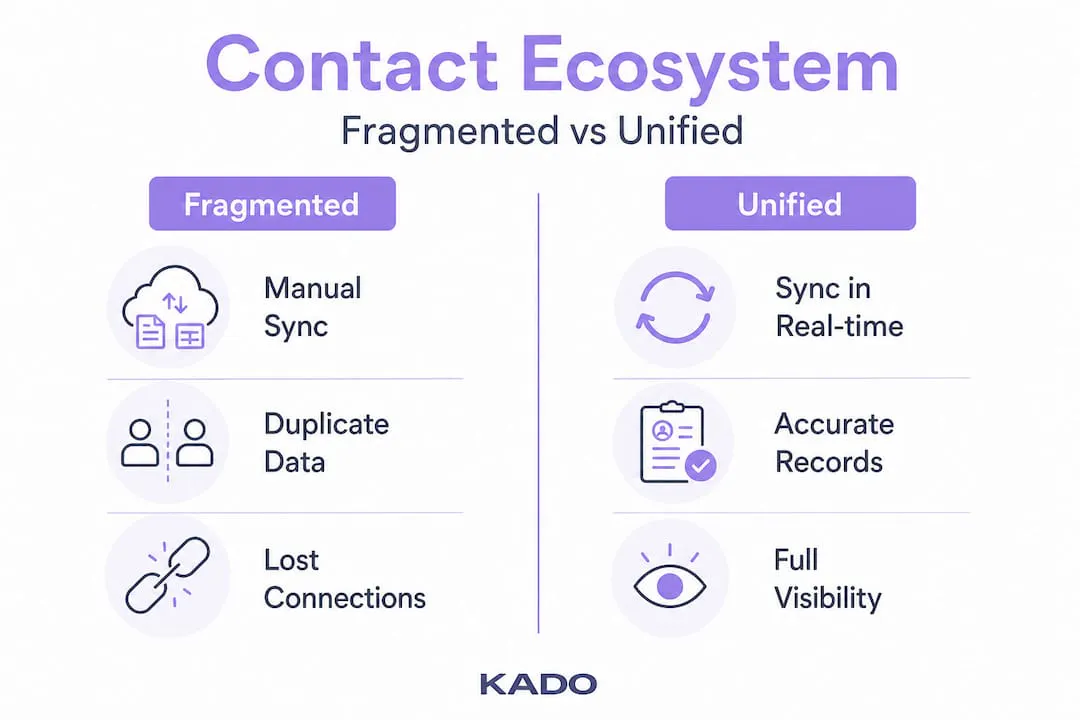
Here is a direct comparison of how different approaches perform across key business dimensions:
| Dimension | Single channel | Fragmented tools | Digital ecosystem |
|---|---|---|---|
Contact data accuracy | High within one tool | Low, often duplicated | High, synchronized |
Follow-up speed | Fast | Slow, manual handoffs | Immediate, automated |
Sales visibility | Limited | Inconsistent | Full journey view |
Customer experience | Consistent, narrow | Disjointed, repetitive | Seamless, personalized |
Team efficiency | Moderate | Low | High |
Scalability | Limited | Poor | Strong |
The business benefits of getting this right are concrete. Teams that maximize lead quality through connected capture and verification tools see measurably higher conversion rates. Research on unified sales platform efficiency confirms that consolidating contact workflows reduces administrative time and accelerates pipeline movement.
The main benefits your team can expect include:
- ✅ Faster follow-up cycles because data moves automatically between systems
- ✅ Higher lead quality because contacts are verified and enriched at capture
- ✅ Actionable insights because all interaction data feeds into a single reporting layer
- ✅ Better customer experience because teams have full context before every conversation
- ✅ Reduced manual entry which lowers error rates and frees up selling time
Pro Tip: Resist the urge to bolt new channels onto your existing stack without auditing how data will flow between them. Adding a new event app, for example, only creates value if it syncs cleanly with your CRM and triggers your existing follow-up workflows. If it does not, you have just added another data silo.
Contact alignment: Synchronizing and verifying contact data
The backbone of a healthy ecosystem is unified contact data. Here’s how businesses ensure their data stays consistent and actionable. Contact alignment refers to the practice of keeping contact records accurate, deduplicated, and synchronized across every platform in your stack. It sounds procedural, but poor alignment is the number one reason ecosystems fail in practice.

A digital contact ecosystem approach requires synchronization and verification of contact data across marketing and sales systems so that data captured in one place is consistent and actionable elsewhere. When this breaks down, the symptoms are hard to miss. Salespeople ask prospects for information they already provided. Marketing sends duplicate emails. The CRM shows three records for the same contact with conflicting phone numbers.
Here are the best practices for achieving and maintaining contact alignment:
- Capture at the source with structure. Use digital business card tools and contact capture forms that enforce required fields and consistent formatting. A phone number entered as “+1 (212) 555-0100” and another entered as “2125550100” represent the same contact but will create two records in most systems. Standardize the format at entry.
- Verify before syncing. Run captured data through email validation and phone verification tools before pushing records to your CRM. This prevents garbage data from contaminating your pipeline. Several platforms offer real-time verification APIs that check records in under a second.
- Synchronize bidirectionally. If a contact updates their job title in response to a marketing email, that change should propagate back to the CRM automatically. Unidirectional sync creates version conflicts and outdated records. Prioritize platforms that offer customer information workflow optimization through two-way data exchange.
- Act on unified data immediately. The value of synchronized contact data is speed. Once a verified record lands in your CRM, your automation should trigger within minutes, not hours. Delayed follow-up is the most common way teams lose warm leads.
Here is a breakdown of how different platform types handle contact verification and the outcomes you can expect:
| Platform type | Verification capability | Typical outcome |
|---|---|---|
Digital business card tools | QR, NFC capture with form validation | Clean records, fast sync |
CRM platforms | Deduplication rules, field formatting | Reduced duplicate records |
Marketing automation | Email bounce detection, list hygiene | Higher deliverability rates |
Event capture apps | Badge scan to CRM push | Real-time pipeline updates |
Contact management solutions | Centralized sync and tagging | Full ecosystem visibility |
Common challenges and solutions: Avoiding ecosystem pitfalls
Even with a clear plan, pitfalls can trip up teams. Here’s how to spot and avoid the most common ones. Building a digital contact ecosystem requires more than choosing the right tools. It requires deliberate workflow design, ongoing governance, and a team that understands the purpose behind each integration.
The most damaging mistake teams make is adding channels without unifying the orchestration layer, which produces fragmented or “seams” experiences. A prospect who interacts with your team across email, LinkedIn, and a live chat tool should feel a continuous conversation. When those channels are not orchestrated, the prospect gets asked the same qualifying questions three times and the salesperson has no record of the earlier interactions. That kind of friction kills deals.
Common pitfalls to watch for include:
- ⚠️ No orchestration layer: Teams add tools without defining how data flows between them, creating islands of information rather than a connected ecosystem.
- ⚠️ Manual data entry between systems: Even a single manual step in your contact handoff process introduces errors and delays. One team member copying contacts from an event app into a spreadsheet can corrupt data quality for hundreds of records.
- ⚠️ No contact verification step: Unverified emails and phone numbers degrade deliverability, inflate your contact database, and waste sales time on unresponsive records.
- ⚠️ Skipping user training: A perfectly integrated stack fails if team members do not understand how to use it. Sales reps who bypass the CRM and manage contacts in personal email create shadow data that the ecosystem cannot touch.
- ⚠️ Ignoring sales touchpoint integration: Every touchpoint, from a digital card exchange to a demo request, needs to feed into a unified record. Missing touchpoints mean incomplete journey visibility.
The solution starts before you choose any new tool. Audit your current workflows first. Map every point where contacts enter your system, where they move between platforms, and where data currently breaks or gets duplicated. For teams managing contacts across physical events and digital channels, tools like property management business cards show how specific industries solve this by embedding capture and sync directly into the networking moment.
Pro Tip: Before adding any new tool to your stack, answer three questions: Where does this tool receive data from? Where does it send data to? What happens when a record conflicts with an existing one? If you cannot answer all three, the integration is not ready for production.
The uncomfortable truth about digital contact ecosystems: What most teams miss
We have reviewed enough technology rollouts to notice a consistent pattern. Teams that struggle with digital contact ecosystems almost always share the same root problem. They treat the ecosystem as a purchasing exercise rather than a design exercise. They buy the CRM, the event app, the digital business card platform, and the marketing automation tool, then wonder why leads still fall through the cracks.
The uncomfortable truth is that tools do not create ecosystems. Workflows do. The technology is only as effective as the process it supports. We have seen organizations with six-figure software budgets lose leads that a well-designed spreadsheet workflow would have caught, simply because no one defined ownership of the data handoff steps.
What successful teams do differently is prioritize workflow orchestration before evaluating tools. They map the contact journey from first touch to closed deal, identify every point where data needs to move between systems, and then select tools that fit those handoff requirements. The technology budget follows the workflow design, not the other way around.
Visibility and control matter more than the number of apps in your stack. A team that can see every interaction a contact has had, verify the data is accurate, and trigger the right follow-up at the right moment will outperform a team with twice as many tools and no orchestration. Practical resources like KADO card best practices illustrate how small, intentional choices about what information to capture and share can have outsized impact on contact quality and relationship depth.
The teams that win with digital contact ecosystems are not the ones with the most technology. They are the ones who treat every contact as a relationship to manage rather than a record to store.
Ready to unify your digital contact ecosystem?
Building a digital contact ecosystem that actually works requires the right combination of tools, workflows, and integration strategy. KADO is designed to fit directly into that ecosystem, connecting digital business card capture with contact management tools that sync seamlessly with your CRM and marketing platforms.
Whether you are a sales team capturing leads at events, a marketing director managing hundreds of contacts across campaigns, or an enterprise organization scaling a global networking program, KADO’s virtual business card solutions give you a clean, verified starting point for every contact relationship. You can also track the performance of your networking efforts with precision using event ROI tracking built for modern go-to-market teams. The ecosystem you need is closer than you think.
Foire aux questions
How does a digital contact ecosystem improve sales team performance?
A unified ecosystem gives sales teams synchronized contact data across every platform, so leads are actionable and follow-ups happen faster, reducing the gap between first contact and first conversation.
What are key components of a digital contact ecosystem?
Core ecosystem components include CRM platforms, digital business cards, event capture apps, marketing automation tools, and unified agent desktops that share data through API-based integrations.
What’s the risk of not having unified orchestration in a digital contact ecosystem?
Without orchestration, teams create fragmented experiences where customers answer the same questions repeatedly and salespeople lose context between touchpoints, which directly damages conversion rates and trust.
How can companies ensure contact data stays accurate across platforms?
The most effective approach is to synchronize and verify data at every capture point using integrated platforms and scheduled workflow audits, preventing duplicates and outdated records from degrading pipeline quality.