Zurück zur Beitragsliste
Enterprise networking: Secure, scalable connectivity for growth
Zuletzt geändert: May 13, 2026


Enterprise networking goes beyond connecting devices and Wi-Fi, serving as essential infrastructure that enables business processes, security, and growth at scale. It involves strategic design across physical, virtual, and logical layers, focusing on performance, security, scalability, and visibility to support organizational goals. Modern approaches like segmentation, Zero Trust, and SD-WAN enhance resilience, security, and connectivity for distributed teams, transforming networking into a competitive business asset.
Enterprise networking is widely misunderstood. Most professionals assume it’s simply about connecting computers and managing Wi-Fi passwords, but that narrow view misses everything that actually matters. Enterprise networks are the underlying infrastructure that keeps sales teams connected, marketing platforms running, and customer data secure at scale. When designed and operated well, they don’t just prevent downtime — they actively drive revenue, enable collaboration, and create the conditions for sustainable business growth.
Key Takeaways
| Point | Details |
|---|---|
Core definition | Enterprise networking is the backbone for secure, scalable digital connectivity that enables business operations. |
Strategic design | Effective networks balance performance, security, scalability, and compliance for real-world business needs. |
Security evolution | Techniques like segmentation and Zero Trust must be aligned with business applications to prevent new risks. |
Modern solutions | SD-WAN and automation are powering distributed teams and seamless access to cloud apps everywhere. |
Business alignment | The most powerful enterprise networks are built in partnership with sales and marketing leaders to drive value. |
Defining enterprise networking: Beyond wires and Wi-Fi
Now that we’ve set the stage, let’s break down what enterprise networking really means in today’s organizations.
When most people hear “enterprise networking,” they picture server rooms and tangled cables. The reality is far more strategic. An enterprise network connects not just devices, but people, applications, data, and business processes across an entire organization, often spanning multiple offices, remote workers, and cloud environments.
As BMC defines it, “Enterprise networking is the physical, virtual, or logical connectivity infrastructure that enables systems and applications to communicate and deliver end-to-end business services.” That framing shifts the conversation from hardware to outcomes. It’s not about the cables — it’s about the services those cables enable.
Understanding the three layers helps clarify this further. Physical networking covers the hardware: switches, routers, access points, and cabling. Virtual networking uses software to simulate those components, enabling faster provisioning and flexible segmentation. Logical networking sits on top of both, using policies and rules to govern how traffic flows, who can access what, and how security is enforced.
For deeper context on why this matters to your career and professional relationships, our networking 101 guide offers a practical starting point.
| Component | Type | Business role |
|---|---|---|
Switches and routers | Physical | Connect offices, devices, and data centers |
Virtual LANs (VLANs) | Virtual | Segment traffic for security and performance |
SD-WAN | Virtual/Logical | Optimize WAN traffic and cloud application access |
Firewalls and ACLs | Logical | Enforce security policies and access controls |
Wi-Fi access points | Physical | Support mobility for distributed workforces |
Cloud gateways | Virtual | Bridge on-premises infrastructure to cloud services |
Each of these components plays a specific role in delivering the reliability and security your teams depend on. When one element is poorly designed or misconfigured, the business impact is immediate — dropped video calls, slow CRM access, or worse, a security breach affecting customer data.
Core elements and design principles for modern enterprises
With foundational elements defined, it’s essential to understand what truly separates effective enterprise networks from simple IT setups.
A home Wi-Fi network can tolerate an occasional dropout. An enterprise network cannot. The stakes are fundamentally different. Enterprise networking typically includes design and operational practices to ensure secure, high-performance, dependable connectivity across users, devices, apps, and data — including cloud and hybrid integration. That requires intentional architecture, not just good equipment.
The core goals every enterprise network must deliver against are performance, availability, security, compliance, and scalability. These aren’t abstract ideals — they directly affect whether your sales team can access real-time contact data during a pitch or whether your marketing automation platform stays online during a campaign launch.
Here are the design principles that separate networks built to scale from those that become technical debt:
- Segmentation: Divide the network into distinct zones to limit unauthorized access and contain potential breaches before they spread.
- Redundancy: Build in failover paths so that no single hardware failure takes down critical services.
- Scalability: Design for growth from day one — adding a new office or a thousand new devices shouldn’t require a complete rebuild.
- Cloud readiness: Modern enterprises live in hybrid environments. Your network architecture must support direct cloud access without forcing all traffic through a central data center.
- Policy-driven operations: Automation and consistent policy enforcement reduce human error and improve security posture across hundreds or thousands of endpoints.
- Visibility and monitoring: You can’t manage what you can’t see. Full traffic visibility enables faster troubleshooting and better capacity planning.
For sales and marketing directors, these principles translate directly to business outcomes. A well-segmented network ensures that marketing tools and CRM platforms are isolated from riskier network segments, protecting lead data. Redundancy means your team never loses access to a contact management system during a critical campaign window.
Pro Tip: Always align network policy with real application traffic and user requirements before rollout. Policies built in isolation from actual business workflows create friction, slow adoption, and generate endless helpdesk tickets. Involve your professional networking tips mindset here — the same principles of listening and alignment apply to good network design.
Enterprise network security: Segmentation and Zero Trust in action
Security is top of mind for any enterprise. Here’s how modern strategies shape success — and what to watch out for.

Network security has moved well beyond firewalls at the perimeter. Today’s threats assume that attackers will eventually get inside your network. The question is how far they can move once they do.
CISA’s guidance confirms that “a common enterprise networking methodology for security is network segmentation (and, in Zero Trust programs, microsegmentation), using policy enforcement to limit lateral movement and reduce attack surface.” In plain terms, even if an attacker compromises one device, segmentation prevents them from reaching your CRM, financial systems, or contact databases.
Here’s how traditional segmentation compares to microsegmentation:
| Feature | Traditional segmentation | Microsegmentation |
|---|---|---|
Granularity | Coarse (by VLAN or subnet) | Fine (per application or workload) |
Coverage | Network perimeter | East-west traffic inside the network |
Complexity | Moderate | High |
Use cases | Office zones, guest Wi-Fi | Cloud workloads, data centers, Zero Trust |
Visibility requirements | Basic | Deep application flow mapping |
Zero Trust takes this further by requiring verification for every user and device, every time, regardless of whether they’re inside or outside the corporate network. It’s not a single product — it’s a philosophy backed by architecture choices.
A phased approach to Zero Trust microsegmentation makes the transition manageable:
- Map your application flows — Identify which applications communicate with which systems, and what traffic paths actually look like in production.
- Classify assets by sensitivity — Not all data is equal. Prioritize protecting contact databases, financial records, and authentication systems first.
- Implement pilot segmentation — Start with a non-critical workload, apply microsegmentation policies, and validate that legitimate traffic still flows correctly.
- Monitor and refine — Use network visibility tools to identify policy gaps, unauthorized traffic, and anomalies before expanding scope.
- Expand incrementally — Roll out microsegmentation progressively, validating each phase before moving to higher-risk environments.
⚠️ Important: CISA explicitly warns that microsegmentation is not a replacement for a layered defense strategy. It’s one critical layer among many, including endpoint protection, identity management, and threat detection.
Pro Tip: Involve application owners in policy design from the start. Misaligned policies — those built without input from the teams who actually use the applications — are the number-one cause of operational pain in segmentation projects. Learning how to build connections and boost leads requires the same cross-functional collaboration that good security design demands.
SD-WAN and adaptive connectivity: Powering distributed teams
Modern enterprises are often distributed across cities or continents. Here’s how next-gen connectivity keeps everyone in sync.
Traditional WAN (wide area network) architectures were built for a world where all applications lived in a central data center. You’d route all traffic back to headquarters, apply security policies there, and send it back out. That worked when Salesforce and Microsoft Teams didn’t exist. Now it creates bottlenecks that frustrate every distributed team.
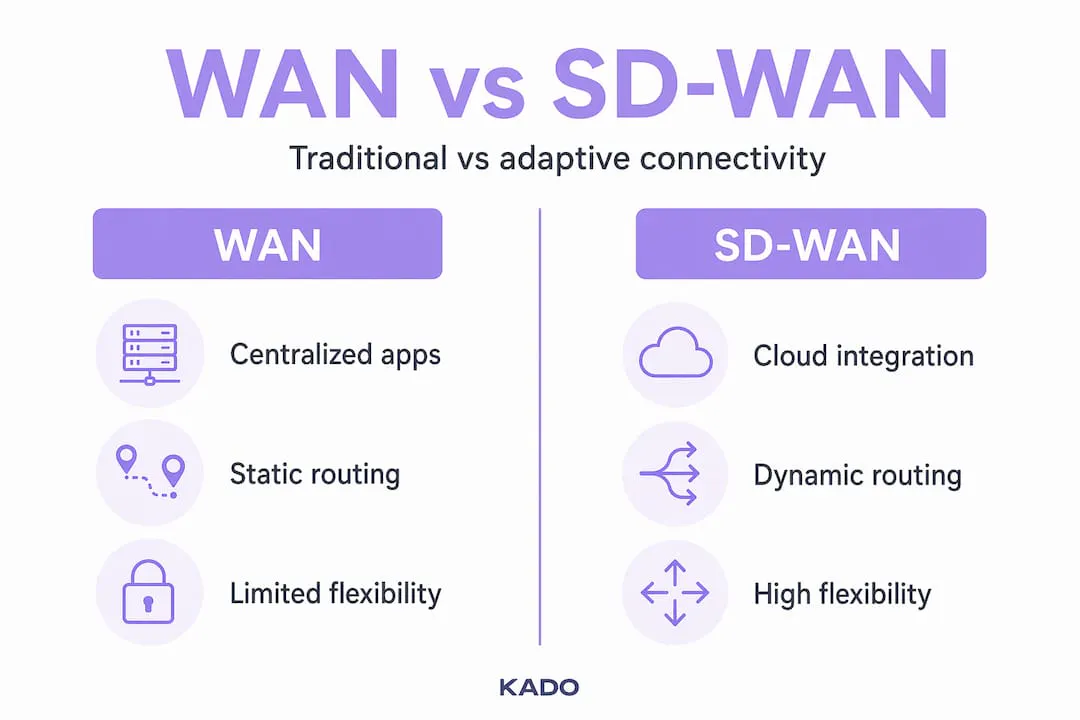
SD-WAN changes this equation. As Verizon notes, enterprise WAN networking is “increasingly implemented via technologies like SD-WAN to provide more automated, flexible, and adaptive connectivity for distributed locations and cloud-based application access.” SD-WAN uses software to intelligently route traffic across multiple connections — MPLS, broadband, LTE, or fiber — choosing the best path in real time based on performance.
The business benefits for distributed sales and marketing teams are concrete:
- Application-aware routing: SD-WAN recognizes high-priority apps like your CRM or video conferencing platform and routes their traffic along the fastest available path.
- Centralized policy management: IT teams can push configuration changes to every branch location from a single dashboard, reducing manual effort and inconsistency.
- Improved cloud performance: By breaking out cloud traffic locally rather than backhauling it to headquarters, SD-WAN significantly reduces latency for cloud-based tools.
- Built-in failover: If one connection degrades, SD-WAN automatically shifts traffic to the next best path — often with no perceptible disruption to end users.
- Cost optimization: SD-WAN allows organizations to replace expensive MPLS circuits with lower-cost broadband without sacrificing performance or reliability.
For sales and marketing directors, SD-WAN means your distributed team in a regional office has the same quality access to contact management tools and communication platforms as those sitting at headquarters. That consistency is not a luxury — it’s a competitive advantage. Reliable access enables real-time collaboration, faster follow-ups, and better relationship networking connections with prospects and customers across geographies.
Common pitfalls and real-world lessons from deploying enterprise networks
No strategy is perfect — practical lessons from field experience can save your next project.
Even well-resourced organizations stumble when deploying enterprise network changes. The mistakes are remarkably consistent, and most of them share a common root cause: technology decisions made without sufficient input from the business teams who depend on those networks daily.
ITU Online’s analysis captures this clearly: “Enterprise networking edge cases include segmentation projects failing or being operationally hard when policies are misaligned with real application traffic paths and when complexity grows (for example, over-segmentation causing operational pain).”
The most common deployment mistakes we see include:
- Over-segmentation: Creating too many zones adds complexity without proportionate security benefit. Every segment requires policy management, monitoring, and ongoing maintenance.
- Skipping application flow mapping: Applying segmentation before understanding how applications actually communicate leads to blocked traffic, broken integrations, and frantic rollback efforts.
- Ignoring change management: Network changes affect everyone. Teams that don’t communicate changes in advance face pushback, workarounds, and shadow IT.
- Underestimating operational load: Microsegmentation and Zero Trust architectures require ongoing monitoring and policy updates. Organizations that deploy them without staffing for operations quickly see policy drift and security gaps.
- Treating ‘best practice’ as universal truth: Published reference architectures are starting points, not prescriptions. What works at a 50,000-person financial institution may create unnecessary overhead for a 500-person sales organization.
Mapping business requirements before selecting or configuring technology is the single most valuable step any enterprise can take. Start with questions like: Which applications are business-critical? Who needs access to what data, and from where? What are the regulatory requirements for data handling? Those answers should drive every architecture decision. To understand what approaches fall outside this framework, it’s worth reviewing what is not an example of professional networking — the same critical thinking applies to evaluating your network strategy choices.
Our take: Enterprise networking is business strategy — not just IT
Stepping back from technical details, here’s our hard-won perspective.
We’ve seen organizations spend millions on enterprise networking infrastructure and still fail to move the needle on business performance. The pattern is almost always the same: technical teams make architecture decisions in isolation, and the resulting network reflects IT priorities rather than business goals.
The real payoff comes when enterprise networking strategy is designed alongside the teams it serves — sales directors who need real-time CRM access, marketing teams running multichannel campaigns, and operations managers coordinating across distributed offices. When those conversations happen early, the network becomes a competitive asset rather than a cost center.
Technical choices like SD-WAN deployment, segmentation design, and cloud integration policies aren’t just engineering problems. They’re business decisions that determine whether your teams can operate at full speed or spend their days working around infrastructure limitations. Treating them as IT-only decisions leaves significant value on the table.
Pro Tip: Approach network transformation the way you’d approach any major business initiative. Define the ROI you expect, create phase gates to validate progress, and measure outcomes against those commitments. Without those guardrails, enterprise network projects routinely run over budget and under-deliver. For inspiration on outcome-driven planning, see how proven networking event benefits translate strategy into measurable results.
Most organizations also dramatically underutilize what their networks make possible. Your network is a platform — one that can enable faster lead capture, more secure contact sharing, better cross-team collaboration, and stronger data governance. When you start seeing it that way, the conversation about investment and architecture changes entirely.
Ready to connect your enterprise strategy with real results?
Putting enterprise networking strategy into practice requires more than infrastructure — it requires tools that turn connectivity into actionable business outcomes.
KADO bridges that gap for enterprise sales and marketing teams. Our contact management platform is built for distributed organizations that need secure, scalable ways to capture, organize, and act on contact data across every channel. From encrypted storage to role-based access controls, KADO aligns with the same enterprise-grade principles you apply to your network architecture. Our virtual business card manager gives your team a dynamic digital identity that’s as secure and adaptable as your network — shareable via QR code, NFC, or direct link, with CRM sync built in.
Häufig gestellte Fragen
What is the main goal of enterprise networking?
The main goal is to deliver secure, dependable connectivity across all business users, devices, applications, and data — including cloud and hybrid environments — to support measurable service outcomes like availability, performance, and compliance.
How does SD-WAN benefit a global enterprise?
SD-WAN improves automation, performance, and flexibility for distributed teams by intelligently routing traffic across multiple connection types and optimizing access to cloud-based applications without backhauling traffic through central data centers.
What is microsegmentation, and why does it matter?
Microsegmentation divides a network into fine-grained zones at the workload or application level, using policy enforcement to limit lateral movement by attackers and dramatically reduce the attack surface inside the network perimeter.
What’s a common pitfall when implementing enterprise network segmentation?
The most frequent issue is over-segmentation or policy misalignment with real application traffic, which increases operational complexity and creates troubleshooting challenges that can slow the entire organization.
How does enterprise networking support sales and marketing outcomes?
Reliable, secure enterprise networking ensures that measurable service outcomes — availability, performance, and security — underpin the tools your sales and marketing teams use daily, from CRM platforms to digital contact management systems that drive pipeline growth.